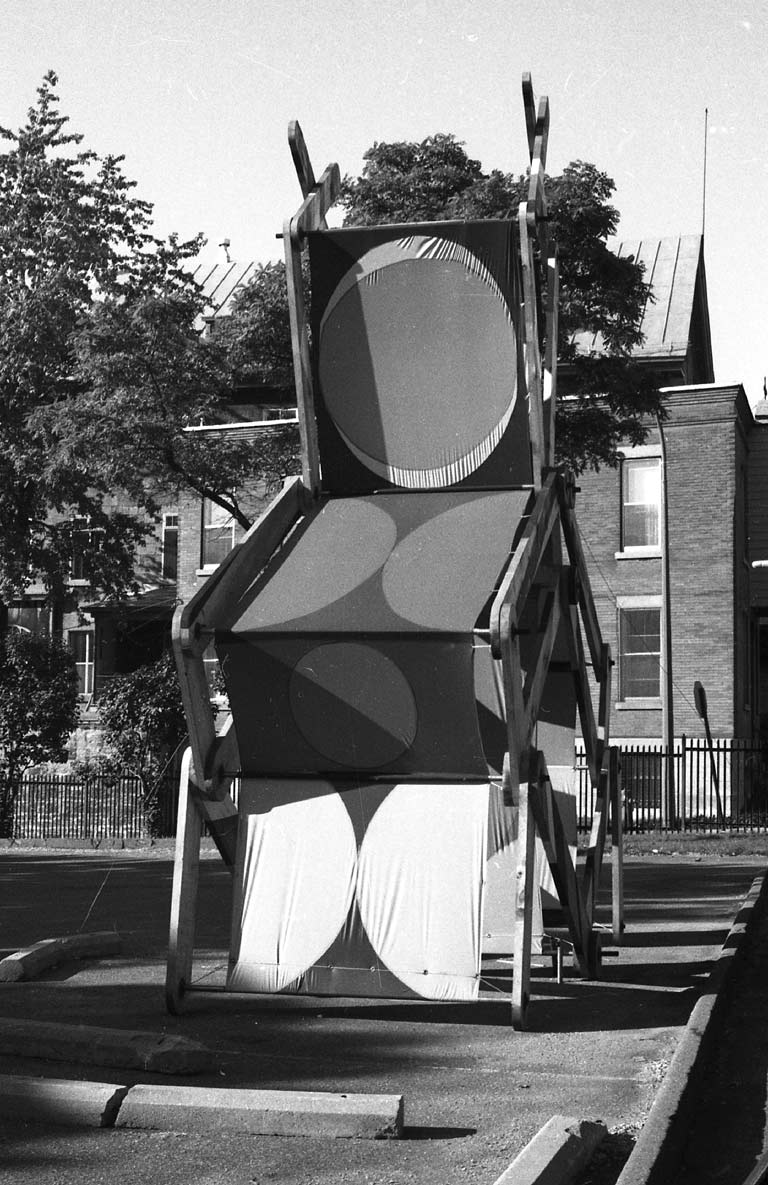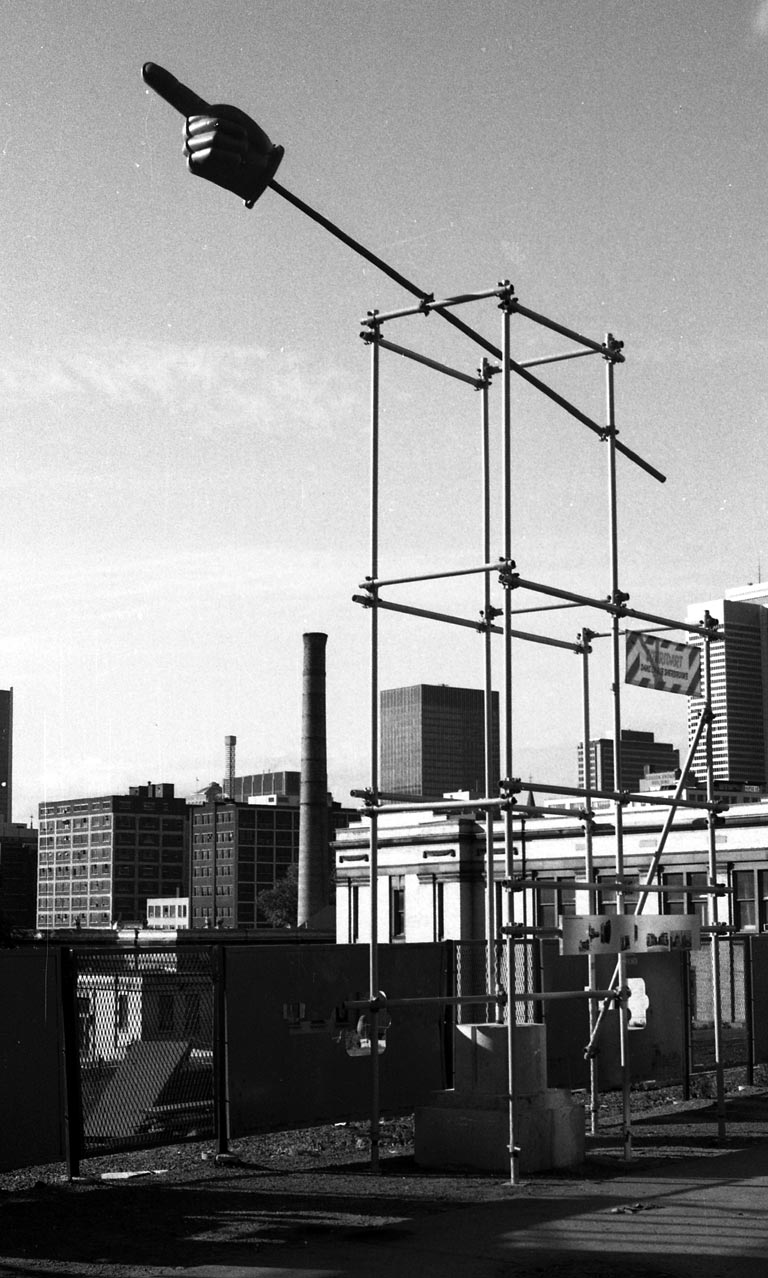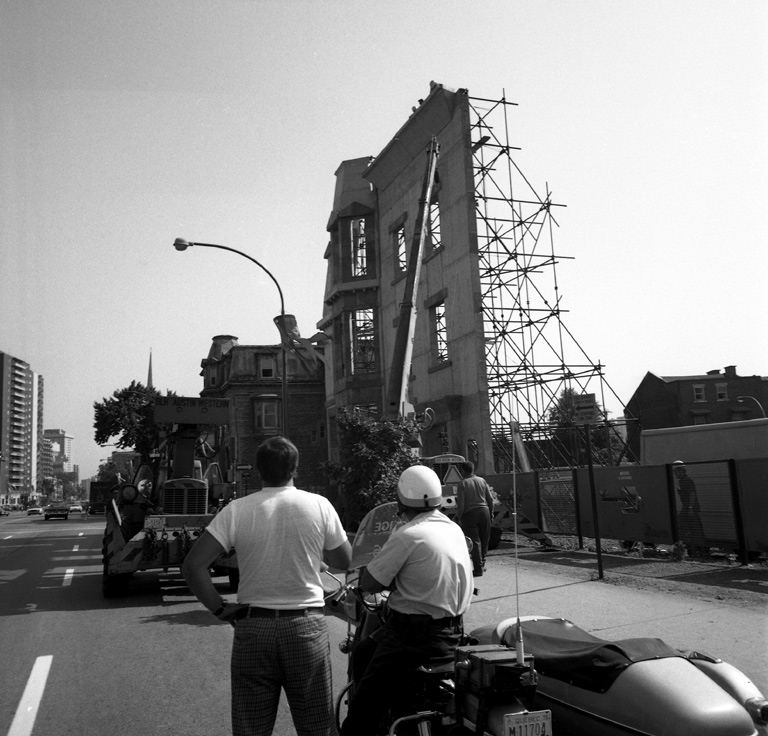
For about a week during the summer of 1976, Montreal’s Sherbrooke Street was a groundbreaking experiment in public art and public history. Contrasting sharply with the slick futurist tendencies of Montreal’s installations for the Olympics and myriad shiny new buildings populating the city centre, the art-and-history exhibit that popped up — seemingly out of nowhere — on the city’s “showcase street” had a distinctly do-it-yourself feel. There were colourful sculptures and banners, a stone maze in a traffic triangle, objects suspended in midair, orange fingers pointing this way and that. And everywhere, photos of the city, of the street, of the city in the street. Of a bygone era. Of something that was missing.
Corridart was a love letter to Montreal, written by the people who had given the city its contemporary cultural cachet. It was a testament to the Montreal that was being torn down to make way for the Olympics, and to the places and spaces the artists, performers, thinkers and teachers who had inspired a generation of Quebec’s cultural avant-garde once called home. It was a defiant act of criticism of the man whose own love for the city put him in control of the wrecking ball.

Your history. Your inbox.
With 7 uniquely curated newsletters to choose from, we have something for everyone.
Above all else, it was supposed to be a gift to the people of Montreal at a time when they were being priced out of their own city. Free entertainment for the vast majority of Montrealers who couldn’t afford the price of admission to watch the Olympics. That those participating in it would actually get some real exercise, engage with the history of Montreal and enjoy the fruit of the city’s artistic community was the gentle mocking irony of it all. Artists working with a small fraction of the Olympic budget could do more to connect people with the culture of Montreal than a splashy billion-dollar spectacle.
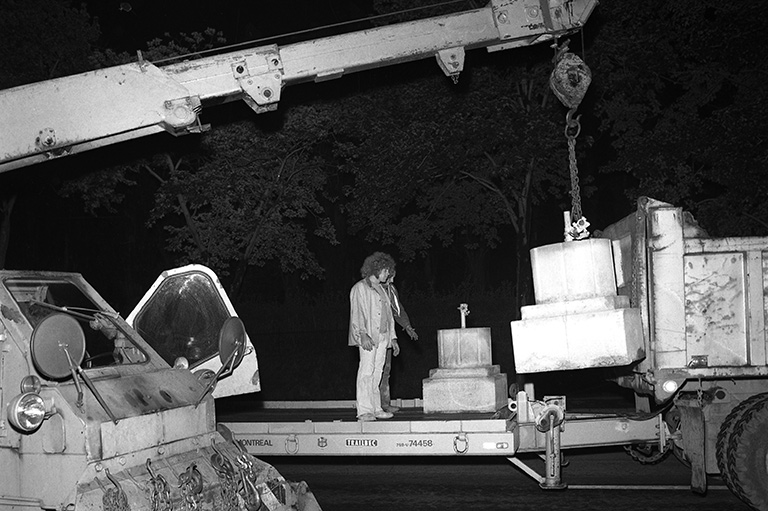
On the night of July 13, 1976, Montreal city workers — escorted by police and under the orders of Mayor Jean Drapeau — began dismantling the exhibit. It is arguably the single-largest act of arts censorship in Canadian history, a desperate effort by a mayor who had lost control of his dream. It was an illegal act, a point that would be proven in court and result in damages paid to the artists a decade later, but not by Drapeau. It set a generation of Quebec artists back considerably since the exhibit was supposed to be their international debut. It was widely reported, and not only in Canada but by the international media as well. Ultimately, it would be more than just one of the many controversies to cast a pall over the Montreal Olympics. In subtle ways, aspects of Corridart would reappear, and the ideas and ideals it explored would, in time, come to be vindicated.
Above all, Corridart was a gift to the people of Montreal at a time when they were being priced out of their own city
Corridart is a rare bilingual portmanteau, a word that symbolically links the linguistic divide and unites the “two solitudes.” Its full name, “Corridart dans la rue Sherbrooke,” was an apt description of its form and function: a corridor of art, set upon Montreal’s most majestic street, a conceptual bridge between East and West, French and English, new and old, rich and poor, yesterday and tomorrow.
Corridart was the principal cultural component of the 1976 Summer Olympics. Funded with a $386,000 grant from the Quebec government, the installation was intended to showcase to an international audience the avant-garde of Quebec’s arts scene. It also harkened back to the artistic competitions that were featured in Olympiads of the first half of the 20th century.
Initially conceived of as a street festival, the notion of a “corridor of art” is credited to Fernande Saint-Martin, then director of the Musée d’art contemporain de Montréal. It was Saint- Martin who subsequently invited the artist and architect Melvin Charney to organize the event. Charney in turn reimagined Corridart as a linear outdoor gallery of monumental art installations running the length of Sherbrooke Street from Montreal’s downtown to the Olympic Park site.
The idea that tourists might walk the six-kilometre distance between the two disparate sites, stopping to view artworks that engaged with the built environment, was rooted in one of Charney’s own favourite pastimes. “Mel loved giving people tours of the city,” says author and journalist Ann Charney of her late husband. “He photographed the city, starting at age 14.”
Mel Charney enjoyed “reading” the built environment, searching for the layers of time in buildings, places and spaces like an archaeologist might read the layers of dirt encasing a buried artifact. Writing a review of Corridart for Artscanada, journalist Dale McConathy subtitled the article “instant archeology in Montreal.”
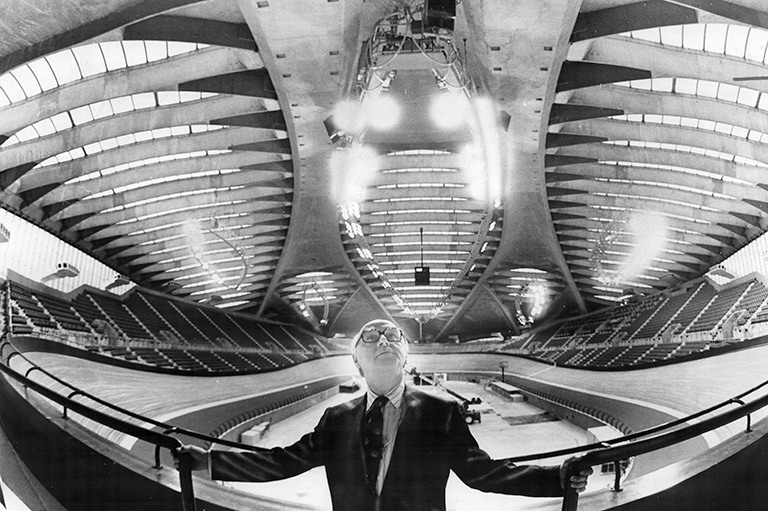
Corridart was composed of five commissioned works, 13 completed works selected by a jury (from a total of more than 300 submissions), as well as an open-air theatre and a venue called Kiosque à broue, both of which had their own programming. Running from west to east, Corridart was a journey through time, connecting Montreal’s oldest building (a stone tower from the late 17th century) to its newest (Olympic Stadium).
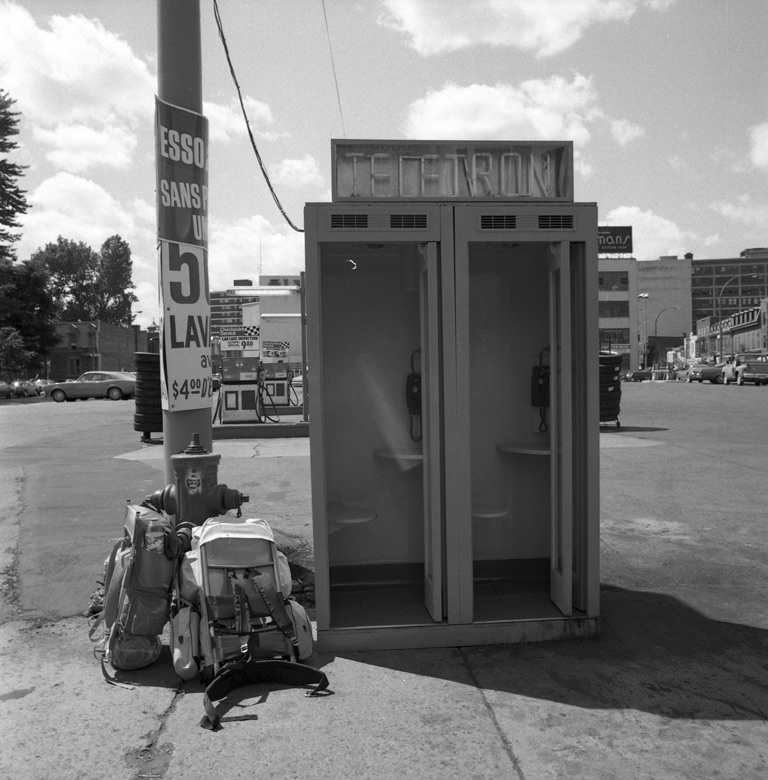
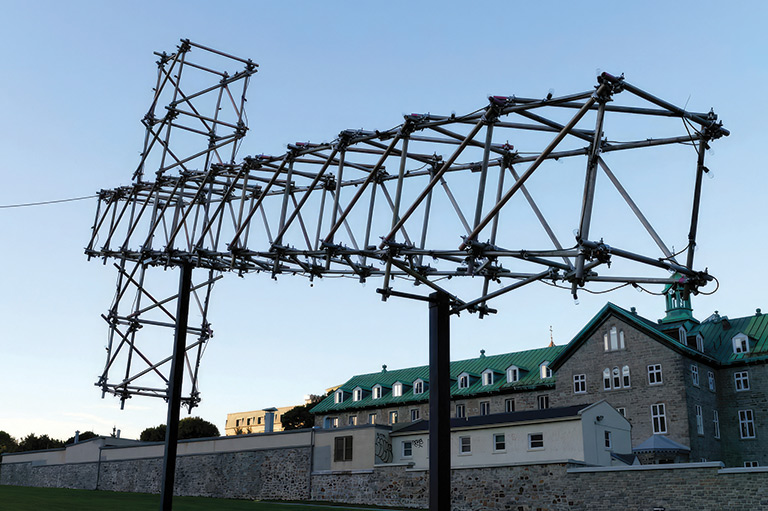
Among the various installations along the way were a stone maze by Bill Vazan; a replica of the cross atop Mount Royal (laid on its side, as if in repose) by Pierre Ayot and Denis Forcier; the photomontage Rues-miroirs by Kevin McKenna; and a series of sculptures by Guy Montpetit. Michael Haslam’s Teletron — two brightly coloured phone booths — allowed passersby to pick up the phone and listen to pre-recorded messages from the “Corridartists.”
While all of the projects were artistic in nature, several engaged with the history of Montreal. Françoise Sullivan, David Moore and Jean-Serge Champagne collaborated on La Légende des artistes, which consisted of six panels and a dozen boxes, the latter composed of photographs, texts, objects and other materials related to artists, writers, arts collectives, galleries and various cultural figures — such as Dr. Norman Bethune — who were significant to the arts community.
Melvin Charney’s primary contribution — Les Maisons de la rue Sherbrooke — also invoked the city’s history. In an empty lot, he built the facade of a house (actually, the mirror image of the building across the street), as a tribute to the historic homes that once lined Sherbrooke.
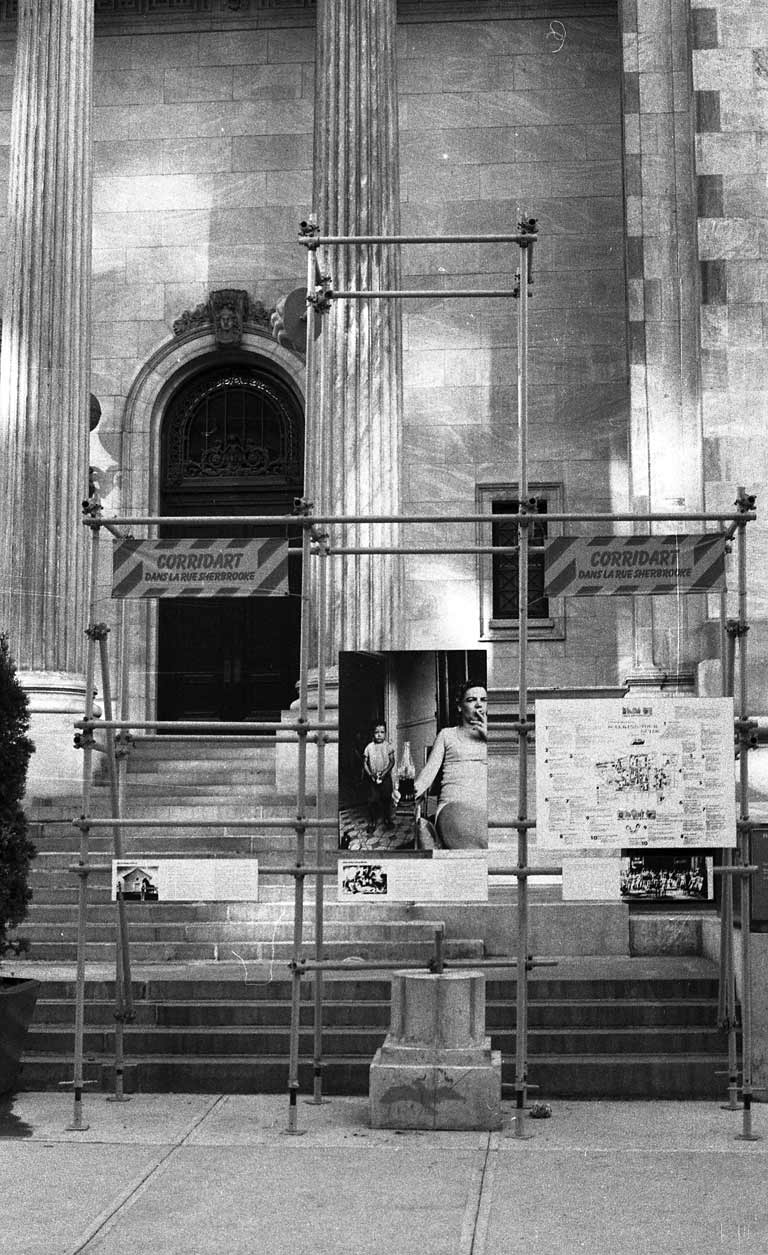
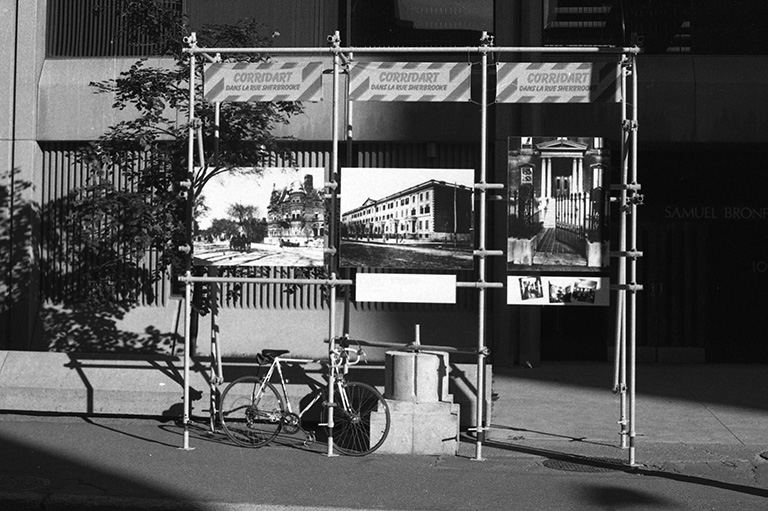
Connecting everything was the project Mémoire de la rue Sherbrooke by Jean-Claude Marsan, Pierre Richard and Lucie Rolland. Mémoire was an innovative project that combined public history, pop art, photography and building materials — in this case, the scaffolding ubiquitous throughout Montreal in the years leading up to the Olympics. The 71 scaffolding installations of Mémoire held letter boxes for Corridart route maps and supported large photographs of street scenes, cataloguing the history of Sherbrooke.
While Corridart wasn’t necessarily political, the exhibit asked critical questions of the Olympics as well as the direction Montreal was taking under Mayor Jean Drapeau. The choice of Sherbrooke Street was significant, as it had historically been the dividing line between the wealthy and working classes, and the main procession for parades. Lined with major institutions (McGill University, Montreal Museum of Fine Arts, École des Beaux-Arts), the street had boasted many of the grand old homes — torn down in the run-up to the Olympics — that once gave it a more residential character. They were replaced with apartment buildings, hotels and office towers. A critical examination of the city’s transformation under Drapeau — including the destruction of several working-class neighbourhoods for new highways and real estate developments, as well as the removal of trees to increase street parking — was the theme of Charney’s well-received but controversial 1973 exhibit, Montréal: plus ou moins.
On the Corridart route map, Charney wrote “Sherbrooke Street has been reduced to a vehicular thoroughfare with few vestiges of its past” and “people who are not aware of their history are trapped by it. By placing history back in the street, an attempt is made to relate the past to the identity of the street as a space shared by people.”
In a 1977 article for Architectural Digest, Charney characterized Corridart as a museum in the form of a street exhibition that explored the neglect and destruction of the city’s street life. He revealed that the provincial government’s Olympics organizing committee had conceived of the arts and cultural component as a means to soften public hostility to the increasingly costly games.
According to historian Matthieu Caron, author of Montreal After Dark: Nighttime Regulation and the Pursuit of a Global City, Drapeau and the members of the city’s executive committee were most offended by Mémoire de la rue Sherbrooke. Specifically, parts of the project demonstrated civic opposition to several of the mayor’s “hegemonic” urban-renewal efforts and effectively argued several vibrant communities that were once adjacent to Sherbrooke Street had been reduced by the city’s elites.
Irrespective of whether Drapeau’s feelings were hurt, Corridart had been funded by the Quebec government, not the city of Montreal. The mayor’s excuse shifted to safety and public security, though he had made his political career by blurring the line between what he considered immoral and what constituted a threat to the public realm.
“In the lead-up to the 1976 Olympics, Drapeau was preoccupied with the city’s aesthetics,” says Caron, noting that this preoccupation went hand in hand with his desire to remake Montreal as a global city of culture.
But Drapeau clung to antiquated ideas about vice and public morality and believed the only way to cleanse the city of its social ills was to rid itself of the physical environments where those ills were found. His first term as mayor, in the mid-1950s, was characterized by slum clearance. In the early ’60s, Drapeau clear-cut so many trees on Mount Royal — because gay men were believed to be cruising there — that locals started calling it “Bald Mountain.”
“At the same historical moment as Corridart, there were raids and crackdowns against the queer community of Montreal,” says Caron. “As Montreal was preparing for the Olympics, there was a crackdown on dissent, and on what people like Jean Drapeau might consider deviant sexuality, or what we today would call non-normative sexuality.”
Drapeau clung to antiquated ideas about vice and public morality
Subscribe to Canada's History
Save as much as 40% off the cover price! 4 issues per year as low as $29.95. Available in print and digital. Tariff-exempt!
As Caron describes in Montreal After Dark, Montreal police raided bathhouses, bars and nightclubs serving the 2SLGBTQ+ community. Simultaneously, they attempted to rid the city of sex workers. These “morality” operations were particularly violent. In one raid, police used axes and crowbars to break down the door of a sauna; in another, police barged into a lesbian bar armed with rifles and cameras. The police dismissed concerns by stating they were “cleaning things up” or looking for “potential terrorists.” In response, Montreal’s 2SLGBTQ+ community organized what was then the largest gay-rights demonstration in Canadian history.
On the night Corridart was destroyed, Ann and Mel Charney had gone out to watch a film, but they were interrupted when Mel got a page and was told to go to Sherbrooke Street as quickly as possible. There, they found city workers dismantling and discarding the installations — with police protection.
“I went up to one of the workers and asked him what he was doing,” recalls Ann. “He looked at me and replied that he was only following orders, a sentence that is particularly inflammatory to me.” Ann Charney is a Holocaust survivor.
Françoise Sullivan had just completed the installation of La Légende des artistes when she heard city workers were dismantling Corridart farther down on Sherbrooke. Years later, she would describe the experience as a rape.
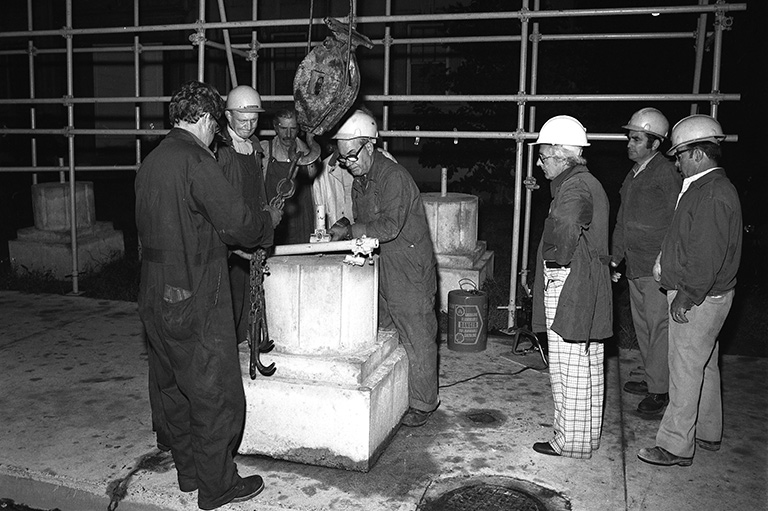
Drapeau ignored provincial Minister of Cultural Affairs Jean-Paul L’Allier’s order to put Corridart back. With the Games less than a week away and already mired in various controversies, an art exhibit that was critical of the host city’s mayor wasn’t going to incite the passions of the political class. Because of the size of the exhibit and of some of the installations, dismantling took several days. Some works were taken down by the artists themselves, though most weren’t and wound up in the municipal dump. Without cause, the city impounded the artworks at the dump for 40 days before releasing them back to the artists — after the Olympics had concluded. Ultimately, several artists, led by Pierre Ayot, mounted a legal challenge against the city, though it would only be settled out of court in 1988 under the mayoralty of Jean Doré. Drapeau never apologized.
Ironically, though the artists felt that Drapeau robbed them of an opportunity for international exposure, the mayor’s monumental act of censorship attracted international attention.
“The loss of the art was dreadful, but on the other hand, it was the last thing Drapeau wanted because the city was filled with foreign journalists,” says Ann Charney. “They probably wouldn’t have ever written about Corridart had Drapeau not torn it down. It was such a blatant act of censorship. It was such a miscalculation on Drapeau’s part.”
Even decades later, echoes of Corridart still pop up hither and yon on the streets of Montreal.
For many years, the McCord Stewart Museum hosted an annual summer exhibit of Notman Collection photographs depicting late 19th- and early 20th-century life in Montreal, akin to Mémoire de la rue Sherbrooke. The annual Art Souterrain festival transforms part of Montreal’s extensive underground-city network into a gallery of public art. A facsimile of Pierre Ayot and Denis Forcier’s La Croix du mont Royal was recreated in 2016, though then-mayor Denis Coderre threatened to pull city funding for the project because he decided it “lacked social acceptability.” Plus ça change. The next year, in the context of Coderre’s overhyped 375th anniversary of Montreal’s founding, a segment of Sherbrooke Street was transformed into an open-air gallery of monumental art installations.
There was no mention of Corridart, no involvement of the Corridartists, nor any recreations of their censored works.
Even decades later, echoes of Corridart pop up on the streets of Montreal
Though Mel Charney and all of the other Corridartists were denied their opportunity to demonstrate what was being lost in the name of progress, by the end of the 1976 Summer Olympics, Montrealers were undeniably ready for change. The first Parti Québécois government was elected just a few months later. Montrealers would say no to a referendum on sovereignty, yes to a new Constitution and begin to critically reassess what had become of their city under Jean Drapeau. Major redevelopment projects fell out of favour as interest in historical and architectural preservation took root. Charney reconnected with an old Yale University classmate — Phyllis Lambert, heiress to the Seagram fortune — when the latter purchased Shaughnessy House and announced it would be restored to its 19th-century grandeur as the central pavilion of the new Canadian Centre for Architecture. Charney’s contribution was the centre’s sculpture garden. The history of Montreal, from its origins as a colonial outpost through to the modern age, can be interpreted through the design of the space and its allegorical sculptures.
It’s Charney’s magnum opus, an unassuming and bucolic retreat from the hustle and bustle of the city, set between (and largely hiding) adjacent highway on-ramps. In its centre is a scale replica of Shaughnessy House, located across the street, bisected laterally, such that it appears to be a ruin. In architectural parlance, it’s a folly, a building without a purpose. And yet, it’s hardly purposeless — people come from all over to see it. It looks like it’s been there forever.
Help keep Canada’s stories true, strong, and free
We hope you’ll help us continue to share fascinating stories about Canada’s past by making a donation to Canada’s History Society today.
We highlight our nation’s diverse past by telling stories that illuminate the people, places, and events that unite us as Canadians, and by making those stories accessible to everyone through our free online content.
We are a registered charity that depends on contributions from readers like you to share inspiring and informative stories with students and citizens of all ages — award-winning stories written by Canada’s top historians, authors, journalists, and history enthusiasts.
Any amount helps, or better yet, start a monthly donation today. Your support makes all the difference. Thank you!