When discussion first arose about Canadian Confederation, the Mi’kmaq were not invited to the negotiations.
Living in their traditional territory — which extended through the British North American colonies of Nova Scotia, New Brunswick, and Prince Edward Island, as well as the Gaspé Peninsula — the Mi’kmaq were concerned about the ramifications of Confederation for them.
The Mi’kmaq Grand Council — a centuries-old governing body — raised funds to send a delegate, Peter Cope, to meet with British Colonial Office officials in London. In 1926 Mi’kmaw Elder Joe Cope recalled how Peter Cope was assured that as long as any Indigenous person “remained a True Ward of the English Government, so long his treaty rights would be respected and adhered to, to Hunt, Fish, and Camp wherever and whenever he lives. No bye-law can ever alter or change his Treaty Rights and Privileges.”
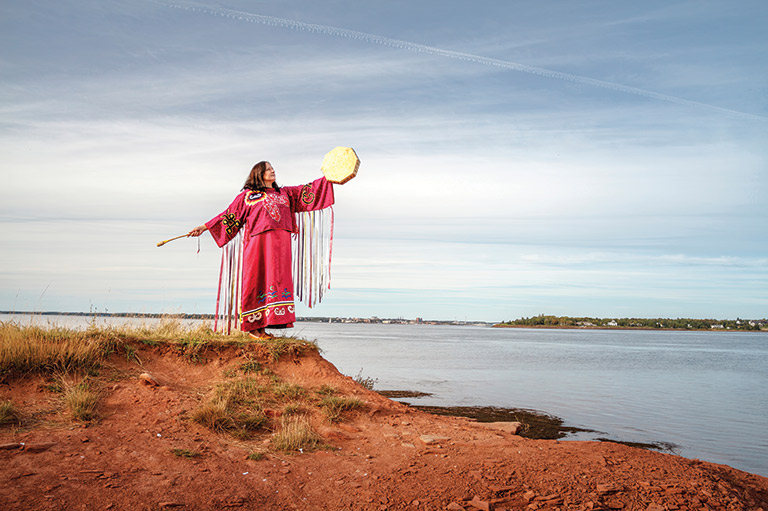
The Treaty rights of the Mi’kmaq date back as far as 1725, when they concluded the first in a series of Peace and Friendship Treaties with the British Crown. The Mi’kmaq have always engaged with newcomers about lands and rights, said Julie Pellissier-Lush, a Mi’kmaw writer and former poet laureate of P.E.I.
In the Peace and Friendship Treaties, the Mi’kmaq — traditional allies of the French — agreed to cease hostilities towards British settlers, and the British agreed to not interfere with Mi’kmaw hunting, fishing, and harvesting. In 1752, a new Treaty confirmed those provisions.
By 1758, the British had replaced the French as colonial occupiers of the island they named Prince Edward Island, and that the Mi’kmaq called Epekwitk. Determined to ensure that British acknowledgement of Indigenous rights included the island, Baptist LaMorue, Chief of the Mi’kmaq of P.E.I., travelled to Halifax, where he signed one of several Peace and Friendship Treaties concluded between the British and Mi’kmaq in 1760–61. Those Treaties guaranteed Mi’kmaq the right to hunt, fish, gather, and earn a reasonable living without British interference, said Tammy MacDonald, a local historical researcher.
A century later, the Mi’kmaq once again asserted their Treaty rights in the changing context of Canadian Confederation. In records published by Mi’kmaw scholar Ruth Holmes Whitehead, Joe Cope recalled the “great agitation” caused by rumours that through Confederation the First Nations in Nova Scotia “would be deprived of all their former Treaty Rights.” Writing in 1926, Joe Cope added his own comment: “Pretty darn near that now.”
Confederation did transfer the Treaty obligation from the old colonies to the new federal government. But Joe Cope’s doubt about respect for Treaty rights was well-founded. In 1927 Mi’kmaw Chief Gabriel Sylliboy was convicted of violating a bylaw by trapping out of season.
At trial Sylliboy accurately paraphrased the 1752 Treaty: “Since I was boy, heard that Indians got from King free hunting and fishing at all times.” But the judge declared that Treaty promises to the Mi’kmaq did not bind the Crown and could be rescinded at any time. It was not until 1985 that the Supreme Court of Canada overturned the Sylliboy decision and upheld the Crown’s Treaty obligations.
On Prince Edward Island today, Lennox Island First Nation and Abegweit First Nation govern the reserve lands of several Mi’kmaw communities. On the island, as elsewhere in Canada, the Mi’kmaq have never ceased to inform a now long-established settler society about the Treaty commitments.
Join us in working toward Reconciliation
Canada's History magazine was established in 1920 as The Beaver, a Journal of Progress. In its early years, the magazine focused on Canada's fur trade and life in Northern Canada. While Indigenous people were pictured in the magazine, they were rarely identified, and their stories were told by settlers. Today, Canada's History is raising the voices of First Nations, Métis and Inuit by sharing the stories of their past in their own words.
If you believe that stories of Canada’s Indigenous history should be more widely known, help us do more. Your donation of $10, $25, or whatever amount you like, will allow Canada’s History to share Indigenous stories with readers of all ages, ensuring the widest possible audience can access these stories for free.
Any amount helps, or better yet, start a monthly donation today. Your support makes all the difference. Thank you!