Your history. Your inbox.
7 uniquely curated newsletters to choose from.


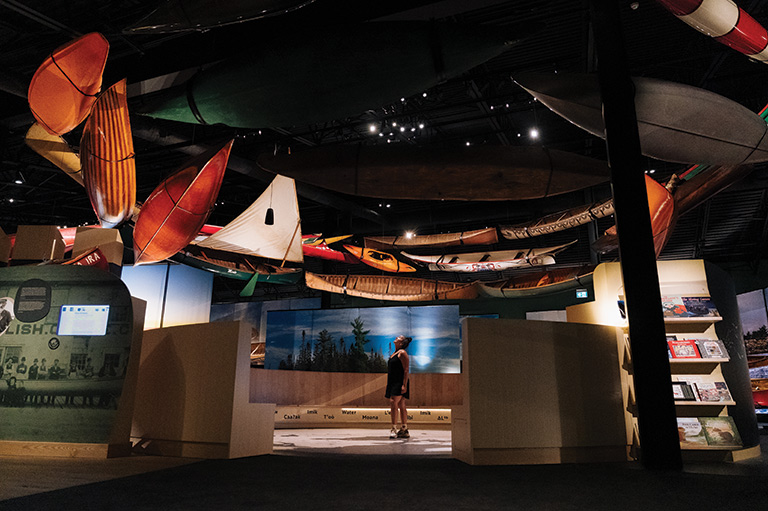
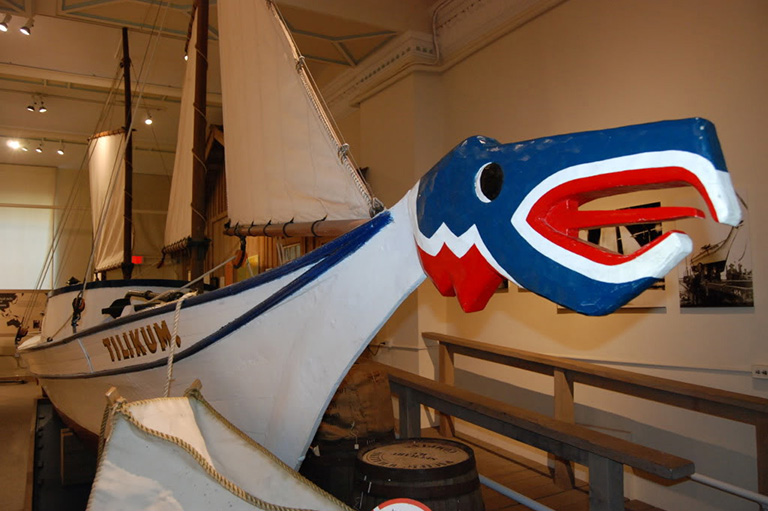
At the heart of the Canadian Canoe Museum’s Exhibition Hall is the Canoe Swirl, two dozen paddled watercraft suspended in layered circles from the ceiling, with a tail that reaches to the hall’s entrance, inviting visitors in. The swirl features an elm-bark canoe, a green sailing canoe with the sail unfurled, an aluminum Grumman, a Haida dugout, a courting canoe and a solo whitewater canoe.
Reminiscent of an eddy, the swirl is a visual testament to the remarkable variation, past and present, in the boats called canoes. Likewise, the canoe has been many things to the diverse people and cultures in the place now called Canada: a relation; a means of harvesting; an instrument of exploration; a spiritual intermediary; a technology of competition; a vehicle for freight; an agent of nation building; a medium of escape; and a symbol of sovereignty, among other things.
It’s fitting, then, to follow the lead of the swirl — choosing circularity over chronology — in telling the story of the canoe’s deep connection to the past, present and future of this place.

With 7 uniquely curated newsletters to choose from, we have something for everyone.
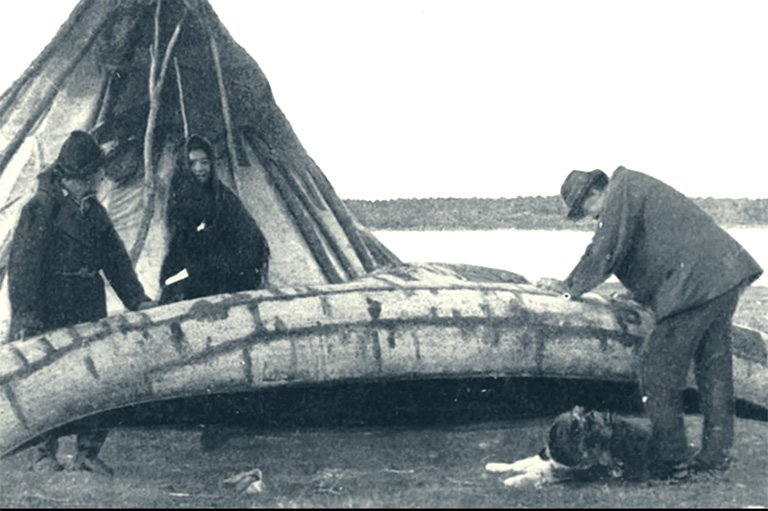
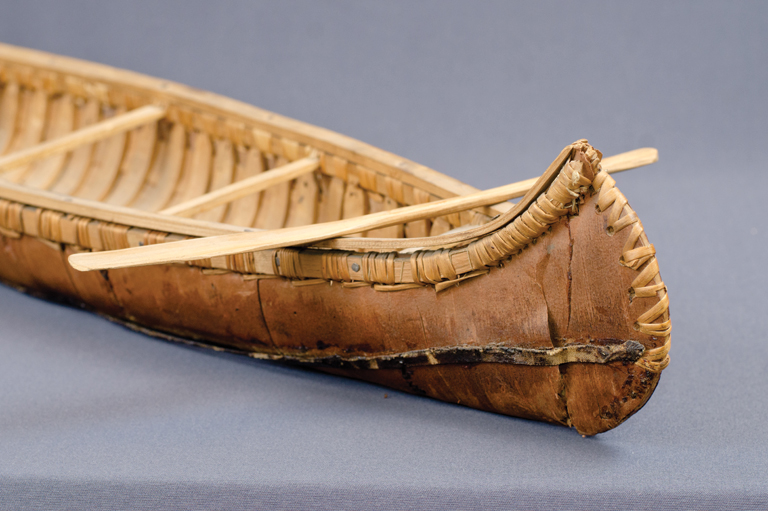
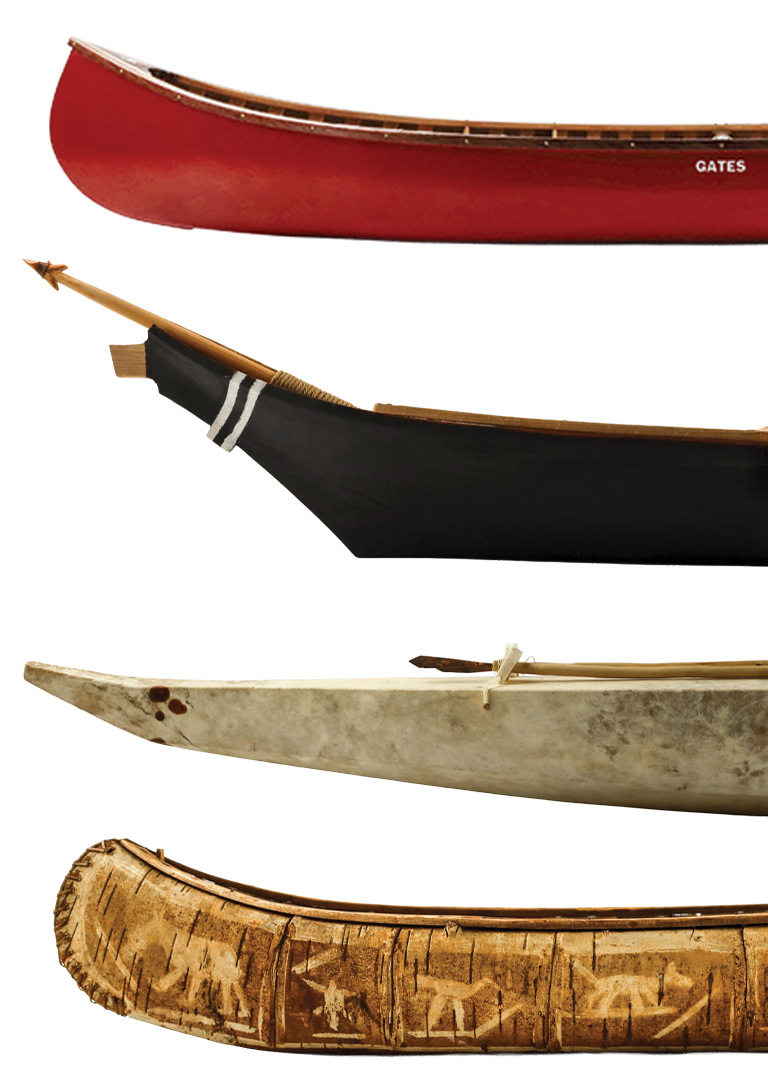
Canoes are first and foremost an Indigenous technology, designed and refined by makers over generations to navigate their home waterscapes, including lightweight birchbark canoes for Denesųłıne following caribou to the tundra; spruce dugouts for Tlingit travelling coastal and inland waters for trade and Potlatches; and rough-water canoes with humped gunwales for Mi’kmaq harvesting whale and porpoise.
More than technologies of transportation and sustenance, for many Indigenous nations, canoes are living things. Freda (Qwi’uminaat) Robinson, a skipper from Stz’uminus First Nation on eastern Vancouver Island, was taught to splash water on the head of the canoe to “wake it up” before setting off. Nations in the Pacific Northwest refer to their “canoe family.” Canoes are kin.
The ancient and reciprocal relationships of care that exist between these vessels and Indigenous Peoples are one of the reasons that canoeing has become an important medium for healing from the traumas of colonization, which include removing Indigenous Peoples from their lands, waters and families. Part of this healing is individual — Hail˜zaqv youth describe releasing their pain into the water with each paddle stroke — but it’s also collective, as paddlers young and old reawaken and share ceremonies, languages, stories, songs and dances.
These relations of care extend to the land and water. Common to many Indigenous nations is a belief that those who are materially grounded in their territories can and will protect them. It was this belief that motivated the TłĮchǫ Nation in the central Northwest Territories to initiate Whaehdǫǫ` Etǫ K’e (Trails of Our Ancestors) in 1995. The canoe journeys that link the four TłĮchǫ communities and culminate at the nation’s annual assembly began while the TłĮchǫ were negotiating a land claim and self-government agreement. Today, 23 years after the signing of the agreement, Whaehdǫǫ` Etǫ K’e continues as a way to nurture relationships between TłĮchǫ Elders and youth, and the land and people, ensuring that critical knowledge and ancestral responsibilities continue long into the future.
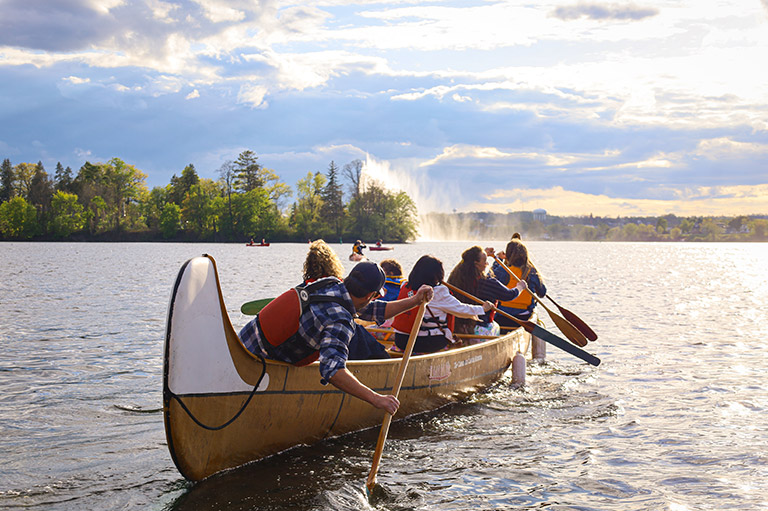
“There is nothing so aesthetically pleasing and yet so functional and versatile [as the canoe]. It is as much a part of our land as the rocks, trees, lakes and rivers”
— Bill Mason, filmmaker and author of Path of the Paddle and Song of the Paddle
Since they were first paddled by European newcomers, canoes have been an important tool of colonization and capitalism, enabling the physical and ideological spread of empire, not least through the fur trade that dominated the colonial economy from the early 17th to the mid-19th century.
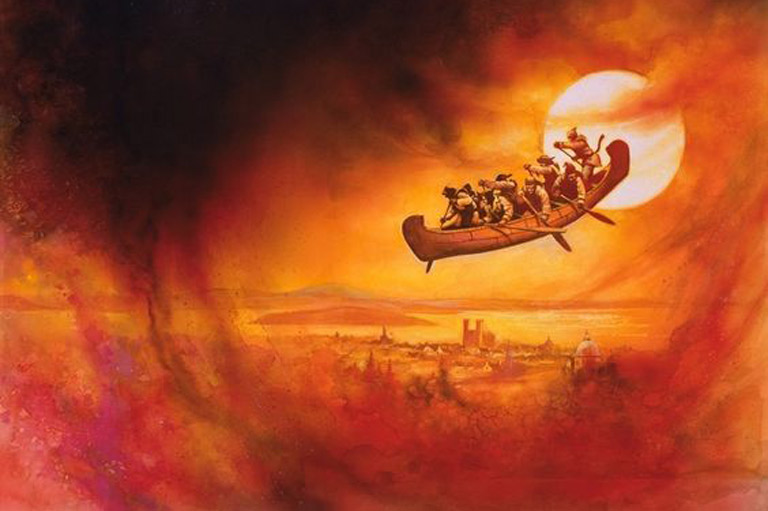
Canoes were the primary vessels for transporting furs and goods between Montreal (the fur trade’s North American epicentre), administrative posts around the Great Lakes and posts in the continent’s interior into the 19th century. The iconography of the trade often features the canot du maître, a large birchbark freighter canoe that could carry 12 voyageurs and 3.6 tonnes of cargo. In reality, however, the canoes supporting the fur trade varied depending on where they were purchased, tailor-made for their environments by local Indigenous builders.
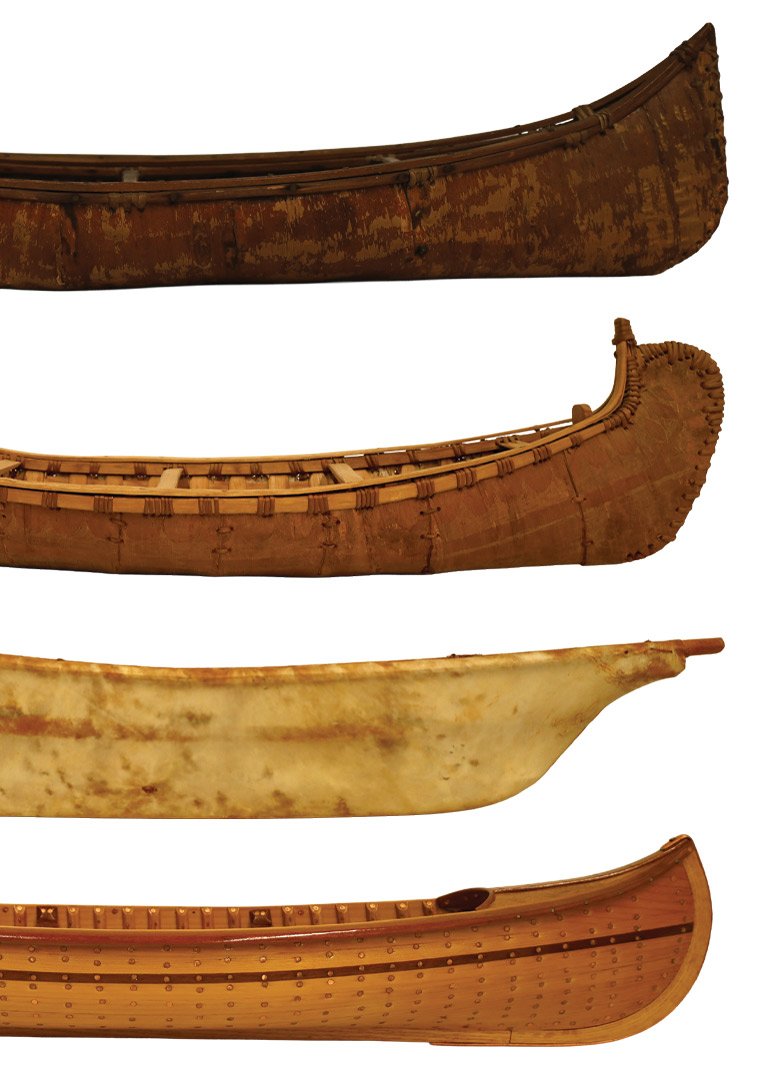
While voyageur canoe travel enriched a certain class of people, for most involved in the fur trade — people like Afro-Ojibwa trader George Bonga and Montreal voyageur Louis Francois Latreille — the canoe was sustenance, a means to provide for themselves and their families.
The canoe was also key to other forms of resource extraction. It facilitated the surveys and exploration work of people like Theodore Link, the geologist credited with “discovering” oil at Norman Wells, N.W.T., in 1920. (Sahtu Dene and Metis had known about and used oil long before Europeans arrived on their lands, including to waterproof their birchbark canoes.) Likewise, such prospectors as Kathleen Rice, who lived and prospected in northern Manitoba, used canoes to traverse the Canadian Shield in search of gold, nickel and other minerals.
In addition to missionaries, explorers, government surveyors and treaty commissioners, canoes carried Indian Agents. Canoes were one of myriad vehicles — alongside trains, schooners, wagons, steamers and planes — used to remove Indigenous children from their families and take them to residential schools. In October 1900, for example, eight children from Nisichawayasihk — Isaac Bohner, Sarah Bohner, Ellen Hart, Matilda Hart, Florence Hartie, Richard Hartie, John Sinclair and Robinson Spence — travelled more than 1,000 kilometres by birchbark canoe, steamer and train to Red Deer Industrial School in southern Alberta from their home in northern Manitoba. Only four of those children survived institutionalization; just three returned home.
Advertisement
At the same time that the federal government was working to sever relations between Indigenous Peoples and their territories through residential schools and reserves, the canoe became a popular recreational craft for Euro- Canadian settlers. Industrial processes and clubs enabled the canoe’s recreational use. It’s no coincidence that the Canadian Canoe Museum is headquartered in Peterborough, Ont., where in the 1850s and 1860s, boat builders including John Stephenson and Harry Strickland were refining the design and production of wooden canoes.
With the exception of the Chebucto Canoe Club, organized in Halifax in the late 1860s, the earliest clubs in Canada date to the 1870s and 1880s. Institutions such as the Brantford Canoe Club (1877) and Toronto Canoe Club (1880) provided a physical space to launch and store boats. They were also social spaces where members could spend time with other enthusiasts on and off the water.
Club members were primarily white middleand upper-middle-class men, but not everyone who paddled was well off. At canoe liveries like those at Trout Lake in East Vancouver or near the LaSalle Causeway in Kingston, Ont., for a small fee people could rent a canoe and paddles for a bit of fresh air, exercise or romance. Indeed, the vessels provided lovers a welcome escape from the prying eyes of chaperones.
While canoeing in the decades around the turn of the 20th century was surprisingly urban, a smaller number of enthusiasts with the means to leave the city behind enjoyed cruising the country’s lakes and rivers using paddle and sail. Canoe cruisers variously extolled the pleasures of time with friends, sleeping under canvas and a physical challenge, though cruising was also inspired by concerns about modern urban life and a belief in the regenerative power of nature.
The popularity of recreational canoeing waned as the 20th century progressed, replaced by motorized pursuits. However, the canoe remained an important part of the summer-camp experience for children of the well-to-do at such private camps as Tanamakoon and Ahmek in Ontario’s Algonquin Park and for a lesser number of working-class children at agency- or church-run institutions like Camp Bolton, northwest of Toronto. At summer camps, past and present, canoeing was one of a number of on-site activities, along with swimming, archery and arts and crafts, and a vehicle for multi-day excursions meant to develop skills and build character.
Canoeing also retained its appeal among those seeking a “wilderness” holiday. Some, like filmmaker, author and environmentalist Bill Mason, were drawn to it by Indigenous paddling traditions and the writings of white practitioners, like “pretendian” Archie Belaney (known in his day as Grey Owl). Others were inspired by the exploits of voyageurs and explorers, including Eric W. Morse, who penned Fur Trade Routes of Canada and coordinated wilderness canoe trips for influential enthusiasts such as Pierre Elliot Trudeau under the mantle “voyageurs.” These canoeists and their acolytes have shaped how Canadians have thought about and experienced canoeing for the past century, as a craft that facilitates spiritual connection with the natural world; a vehicle for accessing and preserving the last vestiges of wilderness; a vessel for facing and overcoming adversity; and a symbol of the nation of rivers.
Save as much as 40% off the cover price! 4 issues per year as low as $29.95. Available in print and digital. Tariff-exempt!
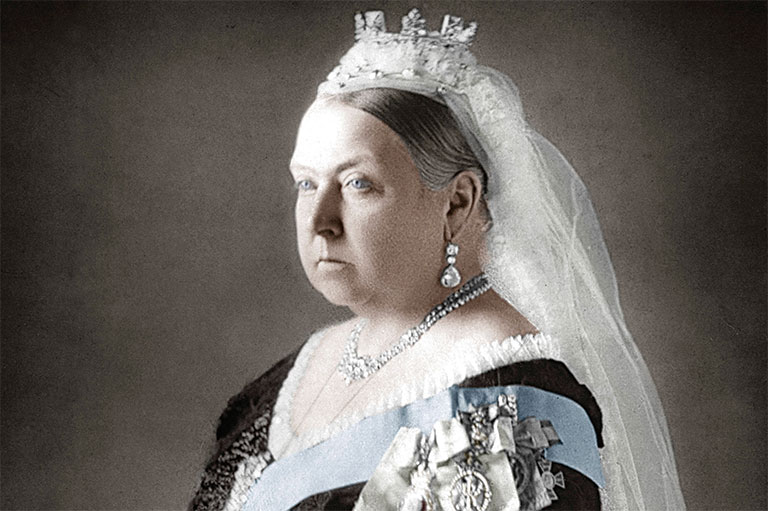
Racing has likely always been part of the canoe story. Contemporary canoe sport, however, has its roots in the mid-19th century, when canoes appeared alongside other watercraft in regattas celebrating colonial holidays. For example, in 1862, at Queen Victoria’s birthday celebrations in Nanaimo, B.C., there were separate canoe races for white men and “Indians.” Only the latter contests had cash prizes — $13, $7 and $4, for first, second and third, respectively — a necessary incentive for Indigenous paddlers to perform for white audiences. Such races were viewed as spectacle rather than contests of skill.
With the founding of the American Canoe Association (ACA) in 1880, canoe sport had a dedicated international venue. The association’s annual encampments and regattas, which moved between sites in the northeastern United States and Ontario, drew competitors from both sides of the border and occasionally from beyond the continent. Otherwise, most of the racers (and the organization’s members) were white middle- and upper-middle-class men. The Canadian Canoe Association (CCA), now Canoe Kayak Canada, was organized in 1900 by Canadian paddlers frustrated with the ACA’s approach to “war canoe,” the large vessels with upward of 15 paddlers.
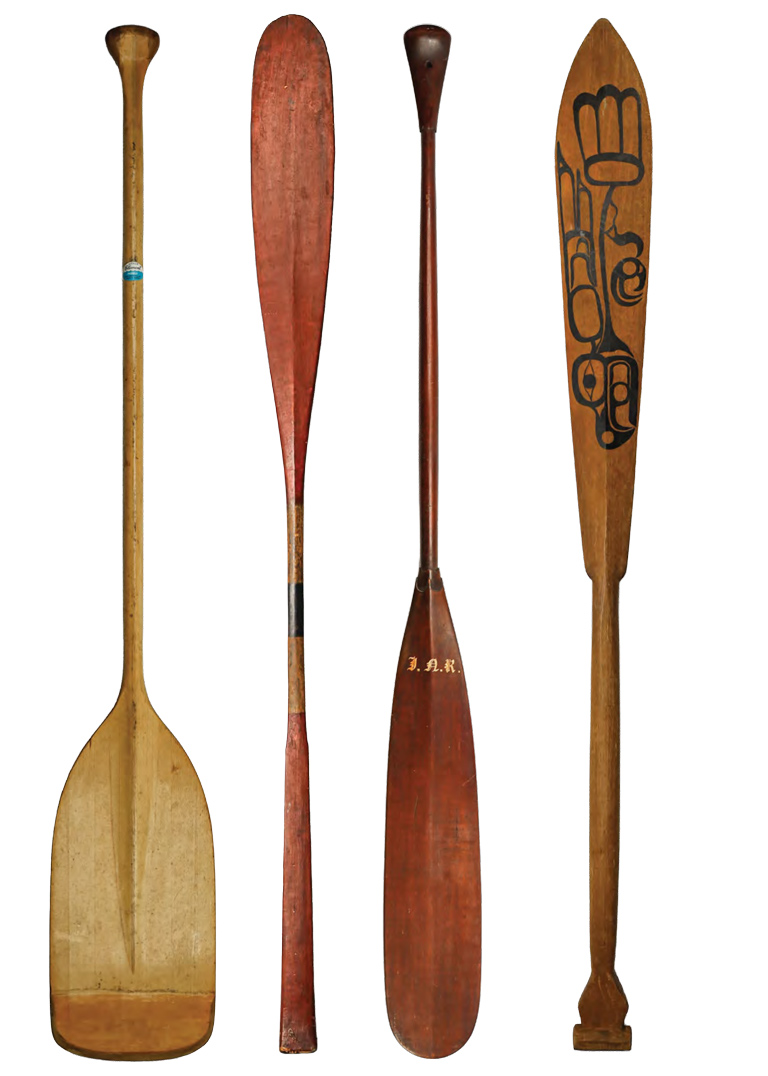
When canoeing debuted as a demonstration sport at the 1924 Olympic Games in Paris, members of the CCA competed against members of the Washington Canoe Club in six contests featuring one, two and four paddlers and single- and double-bladed paddles. Canoeing became a medal sport for men at the 1936 Games in Berlin: Ottawa’s Frank Amyot won gold in the C-1 1000 metre; Harvey Charters and Warren Saker from Toronto’s Balmy Beach Canoe Club took home a silver and a bronze in C-2 10,000 metre and 1,000 metre, respectively. While the inaugural women’s contest at the 1948 London Olympics was called a canoe race, the competitors were seated and used a double-bladed paddle; today, the event would be called K-1.
Canoe slalom — a mash-up of whitewater canoeing and downhill ski racing that dates to the 1930s — was added to the Olympic program for men in 1972 in response to the popularity of whitewater paddling in Europe and former Eastern-bloc countries. The sport didn’t return to the Games until Barcelona, 20 years later.
It took much longer for women to be able to compete in canoes at the highest levels. While the opposition to women racing canoes was partly a function of the general inequities that plague women’s sport, it was also rooted in erroneous assumptions about the impacts of canoeing on women’s bodies: female athletes were told the high-kneel position and unilateral movement of canoe sprint would damage their reproductive abilities.
Finally, after decades of advocacy and activism by athletes like Sheila Kuyper, who founded WomenCan in 1998 to push for equality in canoe sport, women were able to officially compete in sprint canoe at the 2010 World Championships. It was a Canadian, Laurence Vincent Lapointe of Shawinigan, Que., who stood on top of the podium for both the C-1 and C-2. Vincent Lapointe was also on the podium when women’s canoe events debuted at the 2020 Summer Olympics, held in Tokyo in 2021; she won a silver medal in C-1 and a bronze medal with her partner, Mississauga, Ont.’s Katie Vincent, in C-2. The Tokyo Games also included the first-ever women’s canoe slalom event; the top Canadian was Haley Daniels of Calgary, who placed 22nd.
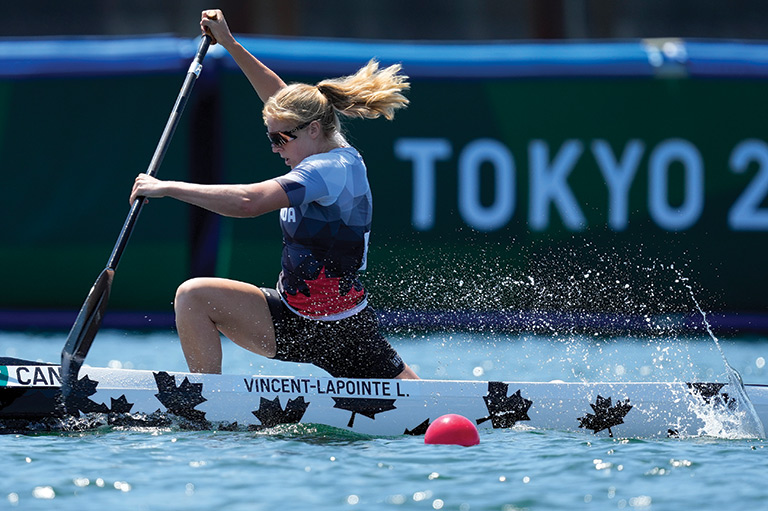
“You might be surprised to know I was terrible when I started.… It took two years, but I finally managed to stay in my boat for a full practice. I was completely in love with the freedom of being on the water and the powerful sensation of paddling”
— Laurence Vincent Lapointe, silver and bronze medallist at the 2020 Olympic Games
Increasingly, the canoe is a symbol of and a vehicle for Indigenous sovereignty and resurgence. Writing in 1995, Kwakwaka’wakw artist David Neel observed, “The contemporary canoe has evolved into an important political tool. It serves to reinforce the existence and continuation of First Nations peoples and cultures in a social/political landscape that has endeavored to make us invisible.”
One of the most visible examples of the canoe as resurgence is Tribal Canoe Journeys, weekslong paddles in the Pacific Northwest that bring together thousands of citizens of Indigenous nations on both sides of the colonial border each year. Tribal Canoe Journeys has roots in the journey made by Loo Taas — the ocean-going canoe designed by Haida artist Bill Reid for Expo 86 — from Vancouver to Haida Gwaii after the expo closed; the Paddle to Seattle in 1989; and the Qatuwas Festival that drew canoes and paddlers to Bella Bella in 1993. Today, Tribal Canoe Journeys is continuing to re-establish the political and social relationships that existed before colonization and “reclaim tradition and territory.”
Reclaimed traditions also include canoe building. Rose Meuse is from L’sitkuk (Bear River First Nation), near the south shore of the Bay of Fundy. An artist, cultural interpreter and Mi’kmaw language instructor, Meuse learned the craft of canoe making from master Mi’kmaw builder Todd Labrador. In 2023, Meuse took the knowledge and skills that Labrador shared and built a traditional birchbark canoe in her home community, the first person to do so at L’sitkuk in a century. The following year, Meuse led the construction of a community canoe at Digby Pines with other members of her nation.
Indigenous builders like Meuse are bringing forward vital and ancient knowledge, ensuring that the canoes that carried their ancestors will also carry their descendants.
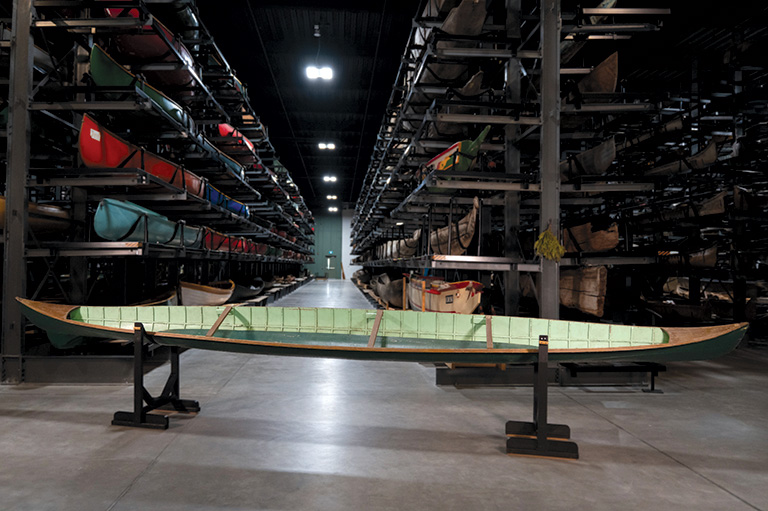
Water sits at the heart of the Canadian Canoe Museum — a connection visitors feel the moment they arrive. At the entrance, a dramatic hydrographic map traces the waterways that have shaped lives and journeys across this land. Inside, the sound of moving water carries through the Exhibition Hall. Many visitors pause here. It’s often the moment they realize they’re stepping into stories much larger than any single canoe — including that of the building itself.
After spending more than a quarter-century landlocked, the museum relocated its collection of more than 650 canoes and kayaks to a new home along the Trent-Severn Waterway in 2024. Getting there had its challenges, including the pandemic and the discovery of groundwater contamination, necessitating a site change.
With a renewed sense of purpose, shared responsibility and care for this collection, the museum designed and purposefully built its new home with Unity Design Studio, an award-winning local firm, and local trades. Collaborative relationships with Indigenous Peoples from coast to coast to coast, alongside paddling and historical communities, shaped the museum and the stories it holds.
Today, nearly 2,000 square metres of exhibitions carry visitors from ancient dugouts and birchbark canoes to modern racing and expedition craft, exploring the canoe’s importance and significance across cultures worldwide and innovations over time, and sharing stories of adventure, resilience and risk.
“When you follow these vessels back to where they came from,” says museum curator Jeremy Ward, “you meet people with diverse perspectives and experience the canoe not only as a watercraft but also as a way of understanding the world and one another.” — Canadian Canoe Museum staff
We hope you’ll help us continue to share fascinating stories about Canada’s past by making a donation to Canada’s History Society today.
We highlight our nation’s diverse past by telling stories that illuminate the people, places, and events that unite us as Canadians, and by making those stories accessible to everyone through our free online content.
We are a registered charity that depends on contributions from readers like you to share inspiring and informative stories with students and citizens of all ages — award-winning stories written by Canada’s top historians, authors, journalists, and history enthusiasts.
Any amount helps, or better yet, start a monthly donation today. Your support makes all the difference. Thank you!
Advertisement