On Feb. 16, 1927, fascism was mentioned for the first time in the House of Commons. Conservative MP Thomas Langton Church, representing the riding of Toronto North, was scandalized that Canada didn’t have a program to protect its coal from the U.S. coal industry. He argued that the country had to develop preferential levies for Canadian and Welsh coal to shelter it.
Church was in the middle of a political career that spanned from 1898 until 1950, including a single term as mayor of Toronto. He blamed Canadian National Railway leadership for “hoisting” U.S. coal on a country that had its own domestic supply, making Canada “absolutely at the mercy of a foreign country for our fuel supplies,” he noted in his remarks. The country’s coal industry was growing and, by 1927, had produced more than ever before — 17 million tonnes, 5.8 per cent more than the year before.
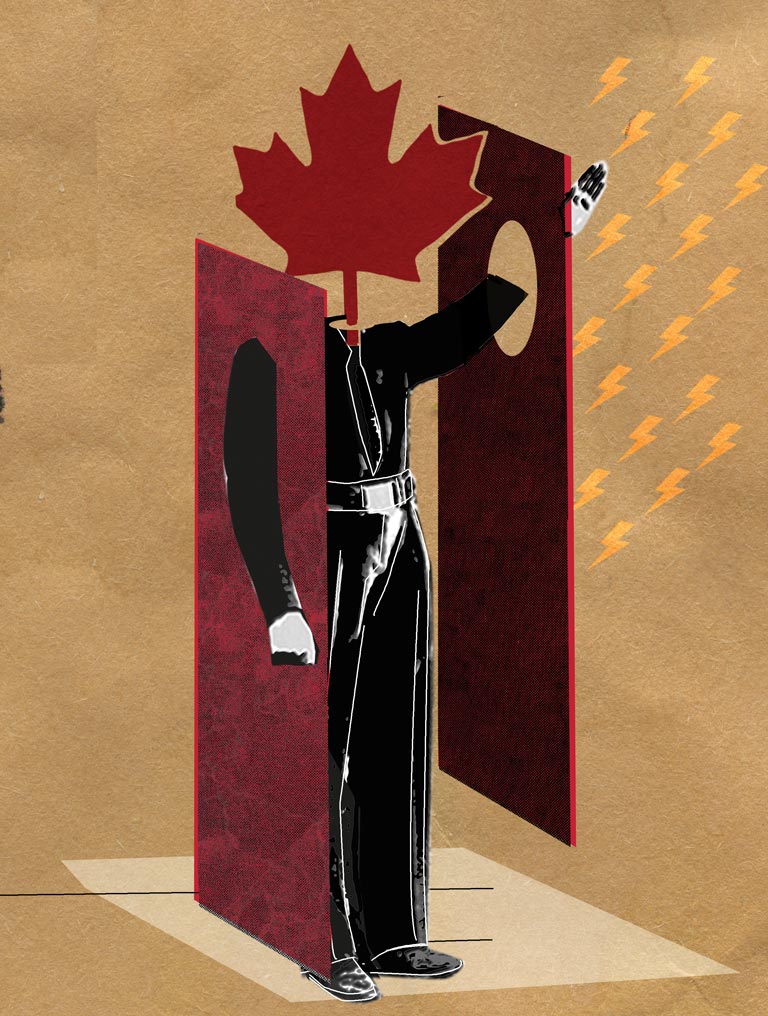
But demand was rising, too; coal use had increased by almost two million tonnes. Frustrated that thousands of empty train cars were running across Canada on a railway built with public money, Church wanted to see our coal in those cars. “The people of this country are looking for a Mussolini to arise in Canada and to solve some of our economic problems,” he said in his speech. After quoting the Italian dictator talking about his party’s successes in rail-system management, he concluded, “That is what this country wants to-day — a modern Mussolini. We require efficient men to manage our railways.”

Your history. Your inbox.
With 7 uniquely curated newsletters to choose from, we have something for everyone.
Church was not an extremist. He was a lifelong Conservative politician who liked what he had heard was happening in Italy. Fascism was a new political movement, and its policies transformed Italy’s struggling economy. While most people today understand that fascism is a hateful ideology that blames minority groups for economic problems they have no control over, from the beginning there were elements of fascist public policy that attracted admirers across the western world. Nearly a month before Church’s comments in the House of Commons, Winston Churchill, then British chancellor of the exchequer, was in Rome where he was quoted in the New York Times to have said, “If I had been an Italian I am sure I would have been wholeheartedly from start to finish with Fascismo’s triumphant struggle against the bestial appetites and passions of Leninism.”
Today, many Canadians express worry about rising fascism. When they share these fears, they’re usually connected to fascism’s most brutal elements: violence, crackdowns on dissenters, hateful policies toward Jewish people and other ethnicities that a regime deems to be deserving of scorn, for example. But fascism is primarily an economic system (see “How Fascism Works” at the end of this article). And our history shows that, in addition to the violent and antisemitic actions taken by fascists, there has always been softer support for fascism among politicians, business leaders and the police.
The Great Depression and radical politics
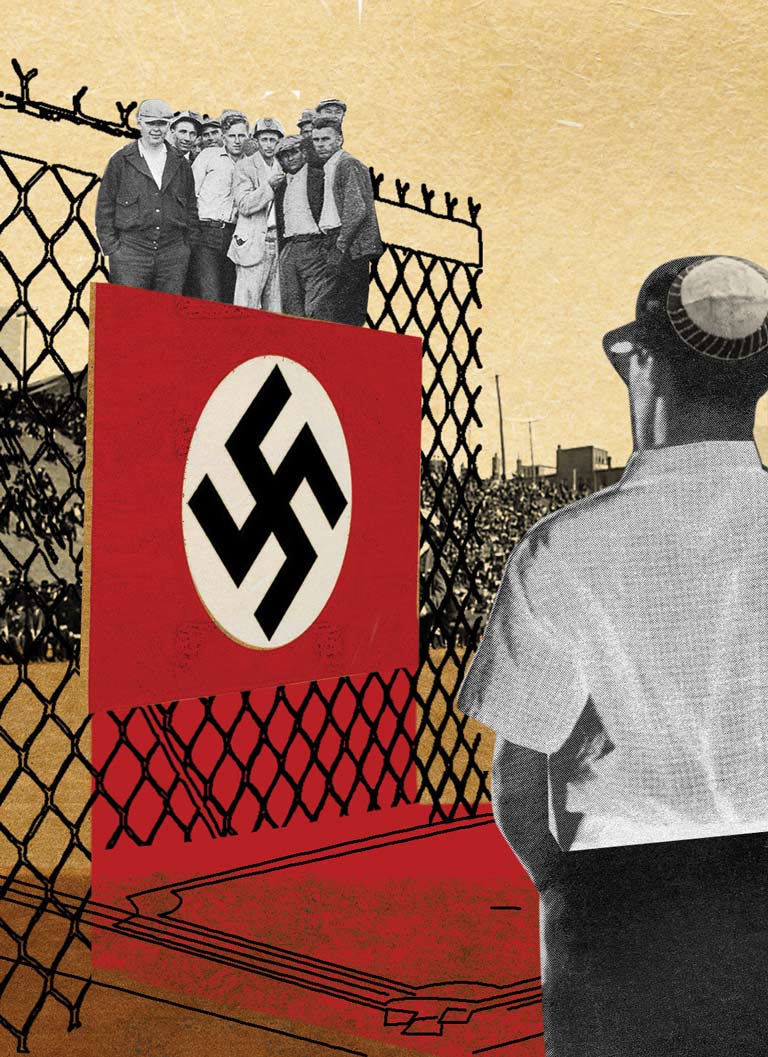
Canada’s fascism story is usually told through the political endeavours of the country’s most notable fascist politician, Adrien Arcand, or violent clashes between fascists and anti-fascists. The Christie Pits riot on Aug. 16, 1933, in Toronto, for example, was one of the country’s most explosive race-based events ever. More than 10,000 people clashed at a baseball game between the mostly Jewish Harbord Playground baseball team and rival team St. Peter’s. Members of the Toronto Swastika Club who came to protest the Jewish team brought a large swastika banner and wrote “Hail [sic] Hitler” on the clubhouse roof. Two days later, the teams met again and members of the club returned to taunt the Jewish players. Jews, backed by communist Italians and Ukrainians, fought the fascists.
Economics often drive political movements, and in the backdrop of the rise of extremist politics was the Great Depression. It hit Canadians hard. One in five was living on relief payments, and the sum of all public and private spending in Canada fell by 42 per cent. On the Prairies, Saskatchewan’s income dropped by 90 per cent in two years, with 60 per cent of its population on relief. The conditions were rife for radical politics, especially among immigrants who were living in precarious circumstances. On the left, socialists and social democrats founded the Co-operative Commonwealth Federation (CCF); in 1933, it issued a manifesto that called for a radically different Canada — one that was more just and equal, where Canadians owned their largest industries and had more direct say in governing the affairs of their country. In 1937, communists and anti-fascists volunteered with the International Brigades to fight fascists in the Spanish Civil War. A large majority of the 1,547 people from Canada who served were of Eastern European descent.
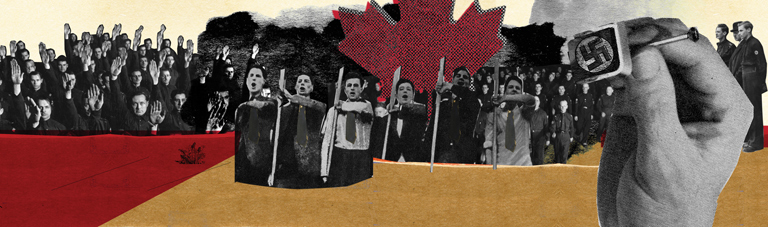
At the same time, the authoritarian ideology found favour among certain Canadians, like the members of the swastika clubs. Those had formed in some parts of Canada during the summer of 1933, not long before the Christie Pits riot. Members believed in British supremacy; in Toronto, they patrolled beaches wearing swastikas to harass Jewish sunbathers.
The clubs didn’t need to try very hard to mobilize people to terrorize Jews. In his book about the Jewish experience in Canada, Seeking the Fabled City, Allan Levine writes, “During the period from the early 1880s to the early 1960s, anti-Semitism was ingrained in the fabric of Canadian society, imposed and practised openly, usually without hesitation, qualifications or shame.… It was not acceptable to have Jewish work colleagues, Jewish neighbours or, worst of all, Jewish members at private sports and social clubs. That was just the way it was.”
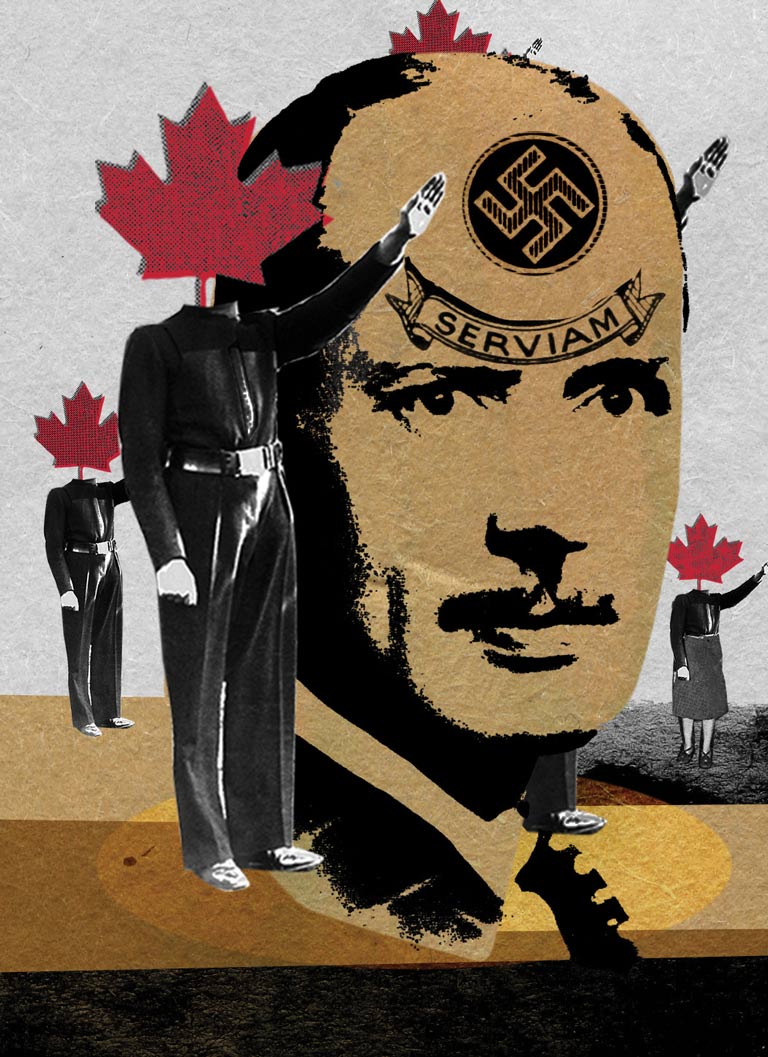
Widespread antisemitism, combined with the fascists’ economic successes in Europe, made it an attractive political movement to some. Benito Mussolini inspired similar movements in Spain, Portugal, Poland, Hungary, Romania, Greece and Turkey. At the same time, Adolf Hitler was developing national socialism — the version his regime adopted and incarnated in the Third Reich. Arcand had been organizing fascist groups since 1929; his highest-profile effort was the National Social Christian Party (NSCP), whose primary goal was to fight Jews and communists, whom Arcand saw as the main opponents to Christianity.
Arcand transcended Canada’s English-French divide and had his hands in fomenting fascist groups across English Canada. The NSCP was connected to the Swastika Association of Canada, a national grouping of swastika clubs. The NSCP was the largest fascist formation in Canada, able to pull crowds as big as 100,000 in Montreal in the mid-1930s. It also, notably, included women, most of whom were the 30-something middle-class wives of male club members. The women helped make party uniforms, fundraise and sell virulently antisemitic propaganda. The NSCP also claimed to have between 60 and 80 women working as maids in prominent people’s homes to spy.
When the NSCP merged with the Canadian Nationalist Party and the Canadian Union of Fascists to form the National Unity Party (NUP), they grew their power such that, by 1939, there were 10,000 paying party members — not insignificant for a country of 11.3 million people. Arcand also had a paramilitary group, popularly called the Blue Shirts, who in turn boasted of having 12,000 members as of March 1938. York University professor emeritus Roberto Perin’s chapter in Minorities and Mother Country Imagery references a claim made by the Italian consul that the Blue Shirts were funded by the Conservative Party of Canada.
English and French Canadians were not the only ones attracted to the movement. Fascist clubs organized within the Italian and German communities were supported by consular offices. One official government report from 1940 found that Italian consuls held a lot of power among Italians in Canada, most of whom needed to stay in touch with Italy for administrative purposes. Any official documents — say, for marriages or immigration — were administrated by the consul. A person who was a fascist could see their documents arrive right away, while a person who was hostile to it might never receive theirs.
Fascism found favour among certain Canadians, like the members of the swastika clubs
German consuls helped launch several German fascist organizations and distribute pro-Nazi propaganda. The most active of these consuls in support of Nazism was in Winnipeg. Additionally, as Thomas Prymak writes in Maple Leaf and Trident: The Ukrainian Canadians During the Second World War, there was some support for fascism among Ukrainians who supported Hitler after he promised to create a Ukrainian homeland.
There were important differences in each community, though. The Italians were less integrated into Canadian society than the Germans and faced more discrimination. They relied on Italian mutual-aid groups and social clubs for daily life, and so not all of the people involved in those groups were actually fascist.
The Italian fascists were strongest in Montreal, where an RCMP report from 1937 noted that the fascist group the Centuria d’Onore marched through Montreal streets in their black shirts several times monthly. Italy’s secret service agency, OVRA, paid close attention to the actions of Italians in Canada, including by keeping track of the political leanings of those who worked on critical Canadian infrastructure. Between 8,000 and 10,000 children went through Italian schools in Canada coordinated by the Italian consuls during the mid- to late 1930s, where they learned about dictatorship and fascism.
Germans however, had been immigrating to Canada for generations and, by the 1930s, comprised about five per cent of the population. The vast majority had few to no ties to Germany. German-coordinated Nazi groups were most interested in Germany-born Germans, and they specifically sought out those of higher social status. The German consul for Winnipeg, Wilhelm Rodde, had worked for Nazi Minister of Foreign Affairs Joachim von Ribbentrop and was a member of the SS. The combined circulation of German newspapers in Canada that were either pro-Nazi or sympathetic to Nazism was 70,000.
State response to rising fascism
For most of the 1930s, the federal government was, at best, indifferent to rising fascism. At worst, there were sympathizers in key positions. The Conservative Party, for example, hired Arcand in 1930 for $18,000 (that’s $350,000 today) to raise support for the Conservatives in Quebec during the federal election. The party hired him again to be publicity director in 1935. Deputy Speaker of the House of Commons Armand Lavergne believed that Arcand and his newspaper Le Miroir were “together important.”
Quebec under Premier Maurice Duplessis was probably the closest that any Canadian government got to total fascism. One article in Time magazine in 1939 described the political culture of Quebec: “Having passed laws regulating if not prohibiting free speech, a free press and free assembly, the reigning Union Nationale Party has long been friendly to a frankly Fascist movement.”
Montreal Mayor Camillien Houde openly supported Mussolini and the Vichy government in France. While he was mayor, he was arrested and interned during the Second World War for opposing conscription. Upon his release, some 50,000 Montrealers greeted him and he soon won back his role as mayor, which he held until 1954.
The Liberal government didn’t demonstrate much concern about Nazism, either, as Hitler consolidated power during the mid-’30s. Prime Minister William Lyon Mackenzie King signed a trade agreement with Hitler’s government in 1936. According to journalist Bruce Hutchison, he thought Hitler was “a simple sort of peasant, not very intelligent and no serious danger to anyone.” In a sweeping history of fascist groups in Canada in the ’30s, Michelle McBride argues in her 1997 thesis for her master’s degree at Memorial University of Newfoundland that due to the government’s lack of anti-Nazi commitment, “opposition to Fascism was led by the Jewish Congress and the Communist Party.”
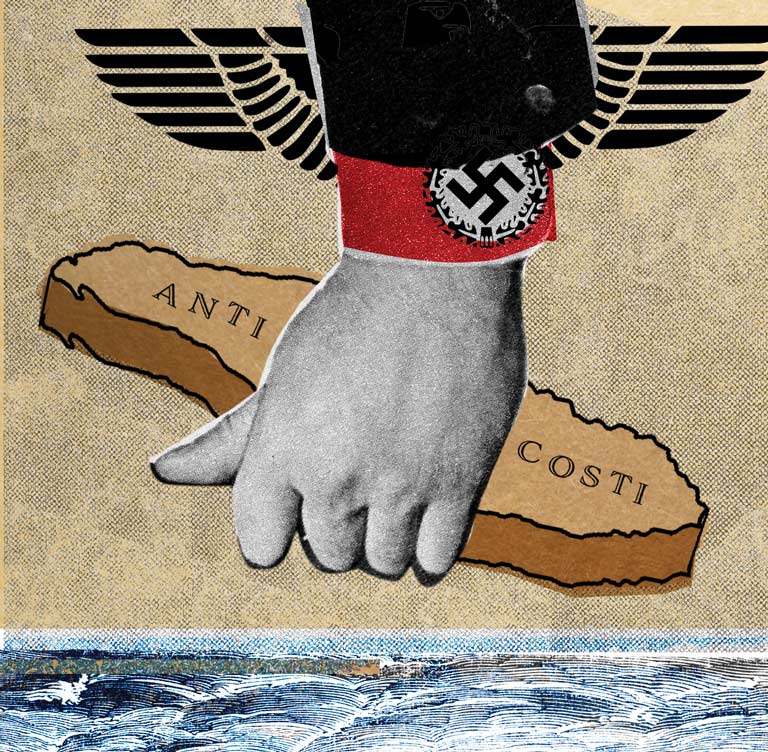
With the proposed sale of Anticosti Island, the federal government finally took the Nazi threat seriously
There were a few exceptions to this. Liberal MP Samuel Jacobs, who was Jewish, from the Quebec riding of Cartier, consistently voiced his opposition to Nazi formations in Canada. (Interestingly, the riding of Cartier would be the only one in Canada where a Communist won a federal seat — Fred Rose in 1943.) In the Montreal Gazette, John Kalbfleisch wrote about how Jacobs pressed Prime Minister R.B. Bennett to say how the government would stop pro-Nazi propaganda that the German consul in Montreal was circulating in 1933. And in 1936, Jacobs demanded to know how the government would react to a German warship, called the Emden, which was docked in the Montreal port. While the ship was in town, the German consul hosted a lavish reception attended by Montreal’s richest families, including the Molsons and other VIPs like Supreme Court Justice R.A.E. Greenshields and war hero Billy Bishop.
When a swastika club tried to organize in Kitchener, Ont., its city council passed a resolution on Aug. 14, 1933, that read, “This city council looks with disfavour upon any organization that among their aims and objectives brings oppression upon and discrimination against any creed … and discourage … the fostering of such an objective by any club or organization.”
As for the police, some of the fascist groups had explicit support from former and current police officers. William Whittaker, founder of the Canadian Nationalist Party (CNP) in Winnipeg, had been a police officer with the Canadian Pacific Railway and a British soldier before starting the fascist group in 1933. His events often had police officers present, “cheering on Whittaker and giving the impression of an alliance between the two,” according to an RCMP report released in February 1934. At the time, the RCMP estimated that the CNP had 3,000 active members. Meanwhile, the founder of the Blue Shirts claimed to have the support of Toronto’s chief of police.
By the time the RCMP started investigating fascist groups in 1933, they’d been closely watching Communists for nearly 14 years. The first file opened on a fascist organization was on the Fascists in Canada, based in British Columbia, on May 10, 1933. And although the Toronto Swastika Club had been terrorizing Jews throughout the summer, the RCMP only opened a file on those clubs on Aug. 12, three days before the Christie Pits riot.
In some quarters of the security apparatus, there was explicit support for the movement. In 1937, RCMP Quarterly published a pro-fascist article by Col. C.E. Edgett, the former chief of police for Vancouver, saying, “Fascists, or Nationalists, are out to preserve nationhood and patriotism by ruthless violence.… The typical Fascist is not perfect by any means nor very admirable from the standpoint of the normal Democrat. But at least he has applied his violence and ferocity to the enemies of traditional family life — to the enemies of religion — and the fascist states, as now established, are ruled neither by mere businessmen nor yet by fanatical revolutionaries.” This was two years after the Nuremberg Laws had been passed by the Nazis and their re-occupation of Rhineland.
International pressure changes attitudes
It would be outside forces and recognition of the direct threat to Canadians that shifted the government’s approach to domestic fascists. In 1937, the German government nearly bought Anticosti Island. Located between Quebec’s Lower North Shore and the Gaspe Peninsula, Anticosti is strategically situated at the mouth of the St. Lawrence Seaway. The Consolidated Paper Corporation had controlled the island, hoping to harvest wood for pulp and paper, which didn’t materialize. In 1938, Bennett, then head of the opposition, argued in the House of Commons that the Germans hoping to buy such a strategic island was part of a Nazi conspiracy to get a foothold in North America. With this proposed sale, the federal government finally took the Nazi threat seriously and its approach to such groups shifted dramatically.
The outbreak of the Second World War triggered the collapse of organized fascism in Canada. In a 2023 article in the journal Central European History, Jennifer Evans, a history professor at Ottawa’s Carleton University, and others write that outwardly Nazi organizations disappeared overnight. By 1940, membership in the NUP was down to 7,083, and in June of that year, the federal government declared the organization illegal. And yet, in 1941, the commissioner of the RCMP, S.T. Wood, still believed Communists were the bigger threat to Canada: “Many may be surprised to hear that it is not the Nazi nor the Fascist but the radical who constitutes our most troublesome problem.” Despite our military engagement against Hitler, there remained some Canadian support for the movement that undergirded his ideology, particularly in the face of communism.
Nearly a century after Thomas Langton Church praised Mussolini’s efficiency in the House of Commons, this extreme form of nationalism has undoubtedly mutated. While there have been a handful of smaller fascist or Nazi groups in Canada in the postwar era, none has achieved the level of support that existed during the 1930s, when supporters could point to fascist governments that seemed to be doing things right.
Many Canadians look at the Trump administration and see echoes of fascist policies — echoes that have bounced around Canada, too. Our housing and affordability crisis has created an increasingly precarious situation. And while the divide between the rich and the poor in Canada has never been larger — including during the Great Depression — Canadians should look to our past to better understand what made fascism so popular. The formula was simple: a promise of better economic days with the blame for financial troubles laid on a scapegoat. It’s a formula that remains relevant today.
Subscribe to Canada's History
Save as much as 40% off the cover price! 4 issues per year as low as $29.95. Available in print and digital. Tariff-exempt!
How Fascism Works
Fascism is a political system that’s imposed through tools such as social control, breaking up labour unions and blaming economic problems on scapegoats (often, Jewish people). One of its main goals is to uphold and manifest corporate power so corporations can grow and profit, which is why corporatism is a fundamental part of fascism. Under this ideology, the economy could be run by a council of corporate executives, hand in glove with the state. Employer associations would bargain on behalf of the employer with employer-controlled employee associations. Ultimately, the goal of this element of fascism is to protect capitalism and the interests of the corporate owners.
But fascist tactics can be used as a means of both holding and achieving power. In his book How Fascism Works: The Politics of Us and Them, philosopher Jason Stanley explains: “Once those who employ such tactics come to power, the regimes they enact are in large part determined by particular historical conditions. What occurred in Germany was different from what occurred in Italy. Fascist politics does not necessarily lead to an explicitly fascist state, but it is dangerous nonetheless.”
A Power Play
Fascism was developed to be the solution to communism, a political system that placed workers, rather than corporate managers and owners, at the centre of economic control. Fascism’s anti-democratic approach venerates a top-down style in all areas of life, explains philosopher Jason Stanley in his book How Fascism Works: The Politics of Us and Them. “The father is the leader in the family; the CEO is the leader of the business; the authoritarian leader is the father, or the CEO, of the state,” he says. Fascism atomizes all other connections to “solve” the tensions of liberal democracy. The result? People are both isolated and primed to support fascist demagogy, especially in times of financial instability.
“The pull of fascist politics is strong,” writes Stanley, a professor at the University of Toronto. “It simplifies human existence, gives us an object, a ‘them’ whose supposed laziness highlights our own virtue and discipline. It encourages us to identify with a forceful leader who helps us make sense of the world, whose bluntness regarding the ‘undeserving’ people in the world is refreshing.”
In the late 1920s and 1930s — with violent revolution in Russia and with labour actions, like the Winnipeg General Strike of 1919, increasing in North America — many western politicians and businesspeople were scared that communism could make its way here and were impressed to see how Italian fascism had managed to crush Communist and trade union organizing while jump-starting Italy’s economy.
Stories you can trust
In today’s environment of misinformation and disinformation, it can be hard to know who to believe. At Canada’s History, we tell the true stories of Canada’s diverse past, sharing voices that may have been excluded previously. We hope you will help us continue to share fascinating stories about Canada’s past, highlighting our nation’s diverse past by telling stories that illuminate the people, places, and events that unite us as Canadians, and by making those stories accessible to everyone through our free online content.
Canada’s History is a registered charity that depends on contributions from readers like you to share inspiring and informative stories with students and citizens of all ages – award-winning stories written by Canada’s top historians, authors, journalists, and history enthusiasts. Any amount helps, or better yet, start a monthly donation today. Your support makes all the difference. Thank you!