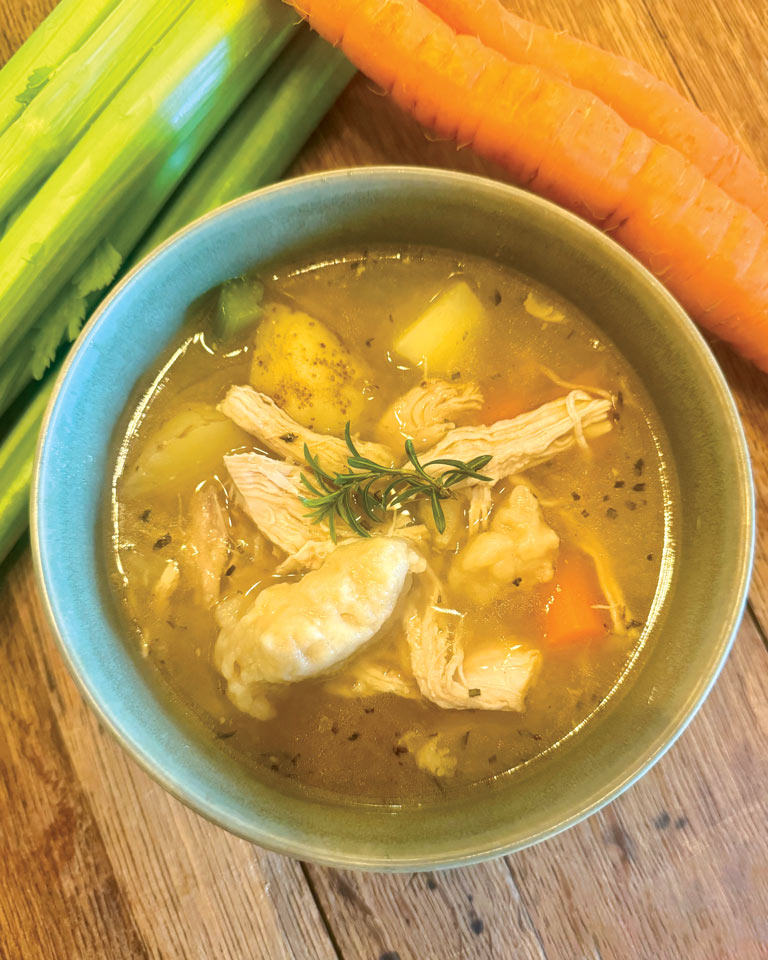
If you’re invited to enjoy fricot in the Maritimes, you might wonder, are you in for a bowl of soup or a gathering? The short answer? Both. “Au fricot” has come to mean a cultural invitation to eat together as well as the delicious dish that shares its name. The word fricot derives from France, and in the mid-1700s, it was used to describe “feast.”
This cost-effective hearty stew with its rich, fragrant broth is made with easy-to-find locally sourced ingredients stocked in most Maritime pantries. As a result, some of the components may be interchangeable; namely, the meat or seafood. However, fricot usually features potatoes and dumplings, also known as grand-pères (grandfathers) or poutine (referencing another Acadian dish, poutine râpée, that’s not to be confused with Quebec’s combo of french fries, gravy and cheese curds). No matter which protein you choose, or if you consider this dish a soup or a stew, fricot is always eaten with a spoon.
The chicken version, known as fricot a la poule, is quintessential in all Acadian culinary repertoires. Traditional recipes often reference poule, or hen, instead of poulet (young chicken), as Acadians tended not to kill egg-laying hens for practical reasons. Since these recipes called for older hens, which are past their egg-laying days and have tougher meat, the cooking times were usually longer. Generally speaking, Acadian cuisine is highly adaptive to the seasons, and fricot is no exception; for such special occasions as Christmas, New Year’s or Easter, rabbit was the meat of choice for this celebratory soup.
How you prepare fricot varies from region to region and family to family. I spent the better part of my formative years in New Brunswick with my Acadian grandfather, and our family recipe includes a classic ingredient; my mother always said it wasn’t fricot until you add summer savory, which gives it a peppery flavour, with hints of marjoram, thyme and mint. Savory also nods to the dish’s French roots, since it’s a key ingredient in the seasoning blend herbes de Provence.
In the modern age, the idea of cooking for others can often leave us feeling intimidated, which creates a barrier for connection. Soups and stews are such versatile and forgiving foods with the innate power to bring physical warmth and emotional comfort; no wonder the Acadians saw it as the perfect medium for celebration and togetherness.
Recipe below...
Fricot à la poule
Total time: 1¾ to 2 hours
Servings: 6 to 8
INGREDIENTS
- 1 whole chicken (about 5 lb)
- 10 yellow-fleshed potatoes
- 3 carrots
- 2 ribs celery
- 1 yellow onion
- 2-3 cubes chicken bouillon
- 1 tbsp dried summer savory (or if using fresh, 1-2 sprigs, finely chopped)
- 1 tbsp pepper
Dumplings:
- 1½ cups all-purpose flour
- 1¼ tsp baking powder
- ½ tsp salt
- ¾ cup whole milk
Directions
In large pot with 10 cups salted water, add chicken. Bring to boil; cook until chicken is tender, about 1 hour.
While chicken is cooking, quarter the potatoes, cut carrots into 1-inch thick coins, and dice the celery and onion; set vegetables aside.
Remove chicken from pot; strain, reserving broth. Set chicken aside and let cool. Remove skin and discard; with fork, remove meat from bones and shred. Discard bones.
Return chicken and reserved broth to pot. Add potatoes, carrots, celery, onion, bouillon, savory and pepper, adding water to cover, if needed; bring to boil.
Reduce heat to medium; cook until potatoes are tender, about 45 minutes. (You will add dumplings during final 15 minutes of cooking.)
Dumplings: Meanwhile, in large bowl, combine flour, baking powder and salt; using fork, gradually stir in milk.
Once fricot has been cooking for 30 minutes, drop batter, evenly spaced, in .-inch mounds into stew; cover and cook until potatoes are tender and dumplings are firm yet fluffy. Season with salt to taste, if desired.
Help keep Canada’s stories true, strong, and free
We hope you’ll help us continue to share fascinating stories about Canada’s past by making a donation to Canada’s History Society today.
We highlight our nation’s diverse past by telling stories that illuminate the people, places, and events that unite us as Canadians, and by making those stories accessible to everyone through our free online content.
We are a registered charity that depends on contributions from readers like you to share inspiring and informative stories with students and citizens of all ages — award-winning stories written by Canada’s top historians, authors, journalists, and history enthusiasts.
Any amount helps, or better yet, start a monthly donation today. Your support makes all the difference. Thank you!