
Oliver C.
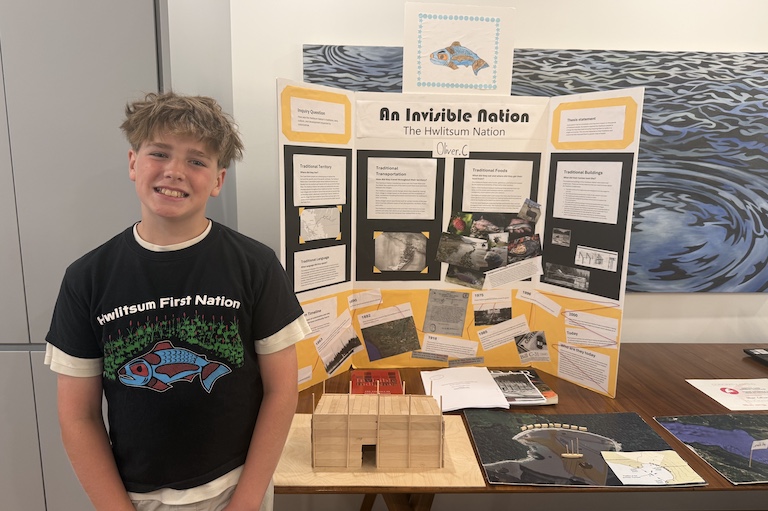
An Invisible Nation: The Hwlitsum Nation
Oliver C.
Vancouver Heritage Fair
Vancouver, BC
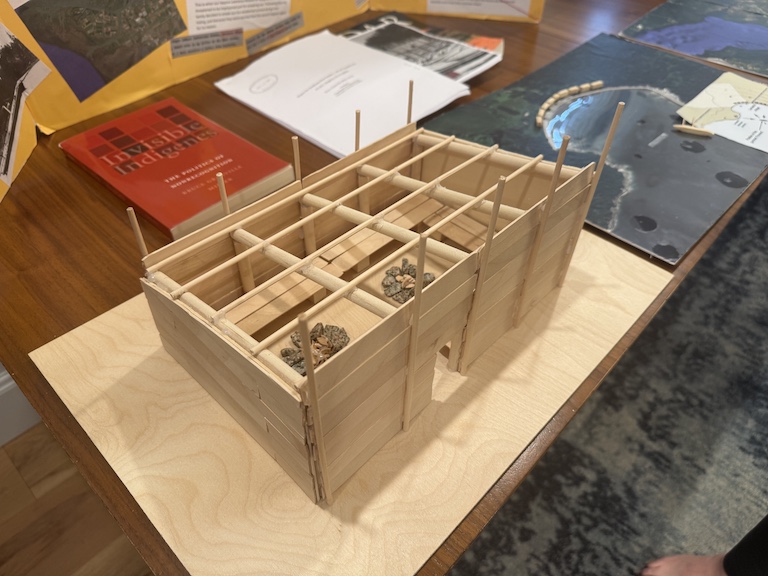
My project is my Nation - the Hwlitsum Nation. The Hwlitsum Nation was traditionally located in Canoe Pass, which is in present-day Ladner and Kuper Island, which is currently named Penelakut Island, where they used Lamalchi Bay as their winter village. The villages were located on opposite sides of the Salish Sea, and they used the tide to canoe back and forth between the villages. The Hwlitsum people lived in Coast Salish longhouses built from western red cedar. A Coast Salish longhouse has a roof with a single slant and no totem pole, whereas a Northwest style longhouse has a totem pole at the front and the roof is slanted on both sides. Inside the longhouses, sleeping platforms wrapped around the interior and fires in the middle were used for warmth and to cook food. Some of the traditional foods they cooked and smoked were elk, deer, salmon and eulachon. They also cooked and ate clams that they harvested from clam gardens which were built and used by the nation to maintain a heathy and safe environment for clams.
In 1863, during a period when they were living at Lamalchi Bay, the Hwlitsum Nation was attacked by the British navy because they thought they were hiding two murderers. Without confirming their suspicions, the British bombed the village. The Hwlitsum people fought back, making the navy retreat. The British people returned with more ships to attack the Hwlitsum nation, but by then the Nation had abandoned their village and moved to Canoe pass year-round.
After about twenty years, the Hwlitsum Nation started using Kuper Island to live again. Then, in 1890, the first residential school was placed on Kuper Island. In 1918, my great great uncle was threatened to be imprisoned for sneaking out one night at this residential school. This residential school was not closed until 1975, over twenty years before the last residential school closed in 1996. In 1985, Bill C-31 was put in place so that Indigenous women could marry non-Indigenous men without their status being taken away. In 2000, the Hwlitsum people were finally recognized with Indigenous status. Today, we are still fighting to be recognized as a distinct Indigenous Nation by the government because, even though the Hwlitsum people have been recognized as Indigenous, the Nation still has not been acknowledged by the government. Despite the lack of recognition, the Hwlitsum people stay connected to our families and the traditions of our ancestors.
Colonization had an immediate and long-term impact on thousands of Hwlitsum people. Europeans required the Hwlitsum people to change the way they lived including displacing them from their traditional territory and villages. This not only impacted their traditions and culture but also exposed them to greater risks of health.
What sources and evidence did you consult for your project? What different perspectives did they provide on your topic?
Report by an Anthropologist
- An anthropologist named Bruce Granville Miller worked with the Hwlitsum Nation and published a report on them confirming their history.
Primary sources
- I gathered information from some of my family members including my dad, my second cousin, my aunt and my grandmother. I have so many other family members that are from this Nation, but we are all still learning about our heritage.
Unique source
- I have a letter clipping from the Indian agent threatening to imprison my great great uncle for sneaking out of residential school one night. This shows how even things that can be forgivable to a non-Indigenous person were not forgivable for an Indigenous individual. This letter clipping was released by Canada’s Truth and Reconciliation Commission.
Secondary sources
- I read books and articles on Indigenous people from the North Coast including a book titled “Cedar” by Hilary Stewart and an article by Christina L. Wallace titled “Architecture of the Salish Sea, Pacific Northwest shed roof plank houses."
What is the historical significance of your topic?
My topic focuses on the impact of colonialization on one Nation – the Hwlitsum Nation. Colonialization had a major impact on my people, including changing how they lived on the land, the food that they ate, and how they passed down our heritage. As my own relatives had to flee and hide, this also had a direct impact on my own life and how I understand my culture. Most importantly, the fact that the Hwlitsum Nation is still not recognized as an Indigenous Nation today means that many of the important things that could support our people are not available.
Why did you choose this topic?
The reason I chose this topic is because I’m from the Hwlitsum Nation and I wanted to learn about my heritage and be able to teach my family about it. Even though we are a part of the Hwlitsum Nation, we do not know very much about our culture because we lost our culture during colonization.