Your history. Your inbox.
7 uniquely curated newsletters to choose from.


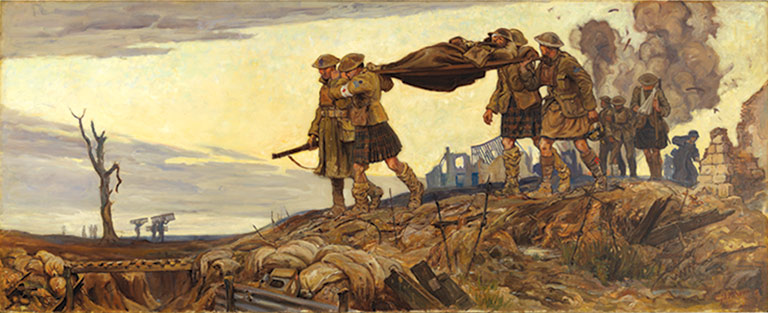
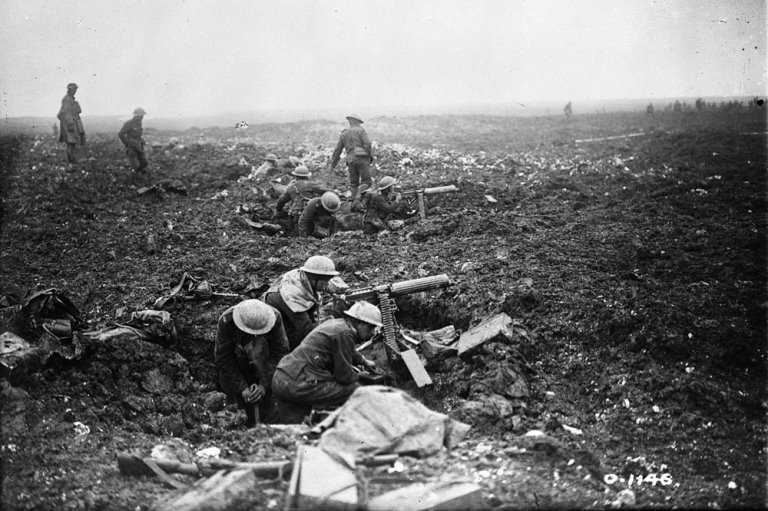
Some of the wounds are so dreadful that one’s most vivid imagination couldn’t even faintly picture them,” wrote Nursing Sister Sophie Hoerner, a Montreal-born nurse who served with No. 3 Canadian General Hospital in the First World War. The modern weapons caused appalling slaughter. The hail of shells and bullets left hundreds of thousands of soldiers dead and maimed from the first months of the war in the summer of 1914, and the fighting on the Western Front degenerated into a stalemate of trenches and barbed wire, with firepower ruling this unexpected battlefield.
As a dominion in the British Empire, Canada was at war when Britain declared war on Germany on August 4, 1914. There was a great rush of men to the colours, and a new, vast army of more than 620,000 soldiers was created that consisted of infantry, artillery, cavalry, engineers, and support formations. But the mass killing caused by industrial warfare also revealed the need for doctors and nurses. By war’s end about half of all Canadian doctors and a third of all nurses had served in uniform, and the Canadian Army Medical Corps (CAMC) had expanded from twenty officers in 1914 to over twenty thousand members.

With 7 uniquely curated newsletters to choose from, we have something for everyone.
These caregivers in uniform were a vital part of the war machine, engaging in preventive care to stop disease from decimating the armies, in surgical care to save the lives of soldiers, and in the long healing process to return the wounded to their units. The high command also came to understand that the medical services were critical to soldiers’ morale, as a breakdown in care that left the wounded untreated to die in agony or from raging infections was understandably a burden on surviving comrades.
No. 3 Canadian General Hospital, initially raised in Montreal in 1914 by the professors and students at McGill University, offers a means to better understand the medical war. Also known as the McGill hospital, it was staffed by hundreds of medical personnel, including such famous doctors as Victoria Cross recipient Captain Francis Scrimger and Lieutenant-Colonel John McCrae — who, although he is remembered as the most famous Canadian poet of the war, much preferred to see himself as a doctor saving soldiers’ lives. Through the hospital and its personnel, one can see the extraordinary challenges faced in caring for the wounded, the emergence of new treatments to better save lives, and some of the crucial lessons from the Western Front that were brought back to Canada in the war’s aftermath to better aid the public health of all Canadians.
The home of the most prestigious medical school in the country, McGill became the first of many universities to form hospitals for the overseas forces. This new unit received funds from the community to purchase modern medical equipment to serve patients in 520 beds — a capacity that was later raised to 1,040 beds. On November 18, 1914, most of the men of military age in the medical faculty, and some who were much older, answered the call to enlist. The hospital’s complement of nurses, led by Matron Katherine MacLatchy, was drawn from Montreal’s two hospitals, the Montreal General and the Royal Victoria. With 33 officers, 73 nursing sisters, and 205 personnel of other ranks (most of whom were McGill students who had been given an accelerated graduation), the hospital unit sailed overseas in early May 1915, threading through the growing packs of German U-boats that sought to sink vessels before they reached England. The hospital would join Canada’s overseas medical services to create, as an official 1919 report noted, a “great machine of healing.”
On a sandy plain at Dannes-Camiers on the French coast, the McGill hospital pitched dozens of tents in early August 1915. A program of beautification commenced with staff laying bricks and seashells to create solid pathways between the 250 huge tents, some of which could hold up to sixty beds. The tents’ vibrant colours and intricate designs made the hospital look deceptively like a giant circus. A rail line led from the front to the coast, and the first patients arrived on August 7, 1915. They were mainly British soldiers who had been wounded by shellfire and bullets in the trenches; general hospitals like the McGill hospital did not treat Canadians exclusively but aided any soldiers who needed medical assistance.
Advertisement
In late September 1915, the British launched a major offensive at Loos, France, which resulted in almost sixty thousand casualties. This was the first test for the hospital staff. The rush of wounded came day and night beginning on September 25, with more than a thousand arriving over the course of a week. “This week — the busiest since we opened — is a confusion to me of blood, gaping wounds, saline, and bichloride,” wrote one private in his diary.
For the surgeons and nurses, it was a welter of bloody bandages over horrendous jagged wounds, with bones jutting through skin, punctured lungs, mangled faces, and bloody cavities large enough to fit a clenched fist. “We have now done over 500 operations and admitted more than 3,000 patients,” wrote Lieutenant-Colonel James M. Elder, the hospital’s officer in charge of surgery, on November 6, 1915.
The hospital was at the end of the chain of medical units in France that started along the Western Front, where soldiers were cut down in the storm of steel. Stretcher-bearers administered immediate first aid on the battlefield and helped the wounded to reach a regimental aid post in the trenches behind the line. There, an infantry battalion medical officer would staunch a patient’s bleeding and send him further to the rear. A few kilometres behind the lines were field ambulances, where more care was administered. But it was not until a patient arrived at a casualty clearing station (CCS) that he was likely to be operated on by surgeons. These small field hospitals had multiple operating rooms, X-ray machines to locate fragments of bullets and slivers of shrapnel in the body, and nurses to offer care and to ensure that infections did not take hold.
After an initial stop at a CCS, the wounded were almost always sent to a general hospital further behind the lines. In many cases, the emergency surgery at the CCS required additional surgery a few days later to remove more lead and steel from the body, address additional wounds, or cut away more infected flesh and muscle to stop an infection. Throughout the war, infections claimed many, despite significant advances. One McGill doctor believed that “90% of war surgery at the base [general hospital] involved a fight against sepsis.”
In the age before antibiotics, most wounds were infected because the battlefields upon which the soldiers fought had been fertilized with animal and human fecal matter for centuries. The whirling steel from the ball bearings, which exploded shotgun-like from shrapnel shells, and the jagged pieces from the shell cases tore through dirty uniforms and skin, piercing the flesh and dragging micro-organisms into the body to fester. New surgical techniques were required, as countless soldiers died from raging infections early in the war.
“This week... is a confusion to me of blood, gaping wounds, saline, and bichloride,”— a private's war diary
Tetanus was a great killer, but doctors eventually learned to treat it with massive doses of serum. That cure did not work for gas gangrene, caused by the Clostridium perfringens bacillus that broke down human tissue, releasing gas bubbles that swelled flesh and caused a gagging stench. After much experimentation, surgeons found that only the technique of debridement consistently saved lives. It involved cutting away flesh and muscle to remove diseased areas and to allow oxygen to kill the bacillus. Elder, the officer in charge of surgery at the McGill hospital, wrote, “I have seen cases in the Operating Room in which the tissues are so rotten with infection that portions of muscle tissue can be removed by the handful.”
The carving away of flesh and the irrigation of these great gaping wounds with saline reduced the toll of deaths by infection, but often when gas gangrene took hold in a limb the only option was amputation. “It is frequently a difficult matter to strike a just balance between the saving of a limb and the saving of a life in these cases,” wrote Elder. “This difficulty is not lessened by the fact that here we were often dealing with infections rarely met with in civil life.”
In the miserable winter of 1915–16, soldiers in the trenches trudged through a slurry of mud, slush, and cold water. At the McGill hospital — which moved from tents into a Jesuit College in Boulogne, France, in January 1916 — patients arrived with a new ailment dubbed trench foot. This injury was caused by standing in cold slush for days on end, which led to constricted circulation, a deadening of feeling in the extremities, and, ultimately, to rotting feet.
Lieutenant-Colonel John McCrae, while serving as the officer in charge of medicine at the McGill hospital, made a study of this peculiar injury. His report recommended wrapping affected feet in hot cloths and injecting them with a mild astringent. With no shortage of patients, doctors investigated the novel injuries suffered by long-serving frontline soldiers such as the bacterial infections known as “trench mouth” and various unknown influenzas, often labelled PUO (pyrexia of unknown origin). The aim of these medical investigations was to better treat soldiers and to send them back to their units. However, trench foot was one of the more serious injuries, and by the time patients arrived at a hospital one McGill doctor observed that “infection is nearly always present.” Amputation of toes or feet was often the only solution at this extreme stage.
Prior to the First World War, McCrae had co-authored a much-read textbook on pathology, which was widely respected but far from poetry. Having enlisted at the age of forty-one, he was attached to No. 3 Canadian General Hospital, but he left for Europe a few months before the rest of the hospital deployed, in a temporary role as medical officer of the 1st Canadian Artillery Brigade.
Set up in a dugout along the Yser Canal in Belgium during the Second Battle of Ypres in April 1915 — where the Germans unleashed chlorine gas for the first time on the Western Front while launching a massed infantry assault and mercilessly shelling the Allied forces — McCrae worked for two weeks straight, saving lives, watching men succumb to wounds, and rarely resting. Coughing through his gas-corrupted lungs, he kept at the surgical work, refusing to leave his post. Writing to his mother that he did not expect to survive the battle, he spared her the horrors, although he noted in one unguarded missive: “Of one’s feelings all this night — of the asphyxiated French soldiers … I could write, but you can imagine.”
To cope with the mangled bodies, unending shellfire, chlorine gas, and sleep deprivation, the doctor composed poetry in his head, running verses and playing with words and imagery. In one lull, he composed the fifteen lines that would become “In Flanders Fields.”
McCrae survived the battle and was redeployed away from the front lines, taking up his post at No. 3 Canadian General Hospital. Traumatized by the unending combat, he suffered from what would now be labelled a mental stress injury. Previously filled with joie de vivre, he emerged from combat as a man given to brooding, quick to anger, and exceedingly hard on himself and others. Close friends felt he had aged at least fifteen years. “Since those frightful days, he has never been his old gay and companionable self, but rather has sought solitude,” wrote American medical officer Harvey Cushing, who was serving at a hospital behind the lines and later became a famous brain surgeon.
Although he would eventually regain much of his good cheer, McCrae was suffering from a new type of wound: shell shock. From the start of the war, soldiers broke down from the burden of prolonged service, often with a single traumatic event shattering their will. All medical doctors struggled to diagnose and then to treat these invisible wounds. Captain Colin Russel, a professor of clinical neurology at McGill University and a specialist responsible for shell-shocked patients during the war, believed it was caused by “exposure to, or the expectancy of being exposed to grave danger, danger clothed in such terrifying forms as a human nature has seldom been called upon to face previous.”
“The boys are very cheerful and make jokes about their missing limbs.”– A.J. Jackson
Most of the shell-shocked patients were sent to speciality hospitals in England and France, but some found their way to the McGill hospital, where doctors treated them with rest and occasional talk therapy. These invisible wounds were much misunderstood at the time. While medical staff tended to be sympathetic, the high command often branded the shell-shocked soldiers as cowards. Many soldiers carried these hidden injuries back to Canada after the war, struggling in private battles to break free of the war that had seared deep into their souls.
At some 10.5 hectares, No. 3 Canadian General Hospital was like a small city. “It is difficult for the civilian who has not been overseas to realize the size and extent of these base hospitals,” wrote one doctor, noting that even the smallest one was able to accommodate “more patients than any hospital in Canada.” In these communities of care, all of the hospitals developed a unique ward culture, with patients singing songs, engaging in therapeutic art, and even putting on skits and plays. At No. 3, there was a newspaper published by the staff, the McGilliken, which contained jokes, poems, and witty prose that today provide insight into how soldiers employed laughter to endure the emotional strain. Gallows humour was common among the patients, who often scoffed at their wounds. A.Y. Jackson, the famous painter who was wounded in battle in early June 1916, wrote to his mother: “The boys are very cheerful and make jokes about their missing limbs.”
Save as much as 40% off the cover price! 4 issues per year as low as $29.95. Available in print and digital. Tariff-exempt!
The fighting in 1916 intensified, as conscripts filled the European armies by the millions. Canada’s primary combat arm, the Canadian Corps, expanded to a third and a fourth division, reaching about one hundred thousand soldiers. Along the front, there was constant “wastage” in the trenches — as the daily losses were clinically and sometimes callously referred to in official reports — as well as larger and more costly battles at St. Eloi and Sorrel in Belgium and on the Somme in France.
“All night I washed dirty, bloody, lousy boys,” wrote a private from the hospital in his diary. “I finished just at dawn, and, looking out of the window, saw passing on a stretcher a still figure, covered with the Union Jack — another name added to the long roll who die for Canada.”
Many soldiers were too far gone by the time they arrived at the operating rooms, while others succumbed to infection in the recovery wards, and this unending death created a deep emotional burden for the caregivers. Some of the soldiers were never known beyond their names; others became friends and shared stories. Nurses often wrote letters home for soldiers near death and even held their hands through the long night as they slipped from this world.
The doctors and nurses of the McGill hospital were overrun in these big battles. There were, for example, 4,600 patients who passed through the hospital between July 1 and July 15, 1916, the first two weeks of the Battle of the Somme. With these waves of wounded, observation and experience dictated that the more lightly injured — those who might recover in six weeks — could remain if there was bed space. But most patients, after undergoing operations, had to be further “cleared” by sending them across the English Channel to more hospitals in Britain.
There the patients underwent additional surgery, amputations, and, if they survived, a period of recovery that lasted several months. At any given point from 1916 onwards, there were thousands of Canadian soldiers being treated or recovering in Britain, although those who would never return to the front were sent back to Canada for rehabilitation and, if possible, training in how to live with their new, scarred bodies.
All the while, the costly fighting at the front continued, with Canadian victories in 1917 at France’s Vimy Ridge in April and Hill 70 in August, and through the mud of Passchendaele, Belgium, in October and November. To respond to the carnage, the McGill hospital raised its capacity to two thousand beds, because even in victory there was terrible bloodshed: 10,600 Canadians were killed or wounded at Vimy, around 11,000 at Hill 70, and 16,000 at Passchendaele.
Further evolutions in treatment centred around the X-ray machine that became increasingly important in assisting surgeons in locating and removing pieces of metal in patients’ bodies. The McGill hospital had an acknowledged expert in Major Alexander Pirie, who published widely about his findings and was recognized as a leader in the emerging field.
The examination of patients and how they died revealed the killing effects of shock from loss of blood. The McGill hospital carried out its first blood transfusion in late 1915, and the Canadians became pioneers of these transfusions at the Somme the following year. Several experts and practitioners would continue to experiment throughout the war, with identifiable results in saving soldiers’ lives.
Many of these lessons — especially in how to treat infections — were learned through trial and error. But with so many professors in the McGill hospital, there were formal and informal lectures about the lessons learned, as well as instruction in life-saving techniques. New doctors were mentored with almost daily instruction, and many doctors in the CAMC published academic articles in the Canadian Medical Association Journal (which was edited by the pioneering heart specialist Maude Abbott of McGill during the war) and in the Bulletin of the Canadian Army Medical Corps, a new journal for service officers that began publication in 1918. Experienced doctors, surgeons, and nurses — especially the Canadian nursing sisters who were in the forefront of specializing in providing anaesthesia for patients — often took temporary posts with other hospitals to share their experiences. There was everpresent learning amid the destruction, and there were always new weapons that demanded rapid reaction.
The injuries caused by gas warfare proved extraordinarily difficult to treat in hospitals. The chlorine and phosgene gases of 1915, which attacked the lungs, gave way to mustard gas beginning in July 1917. This new German chemical agent burned and blinded soldiers while also causing enormous skin blisters that were frequently infected in the unsanitary environment. The McGill hospital received hundreds of cases. Patients arrived blinded from the gas, with their heads wrapped in bandages to protect their eyes. Doctors and nurses soon learned that uniforms had to be cut away, as they were contaminated with the gas. The potent chemical plague could blind and burn caregivers, who sometimes had to work on the injured patients with protective gloves. Even then, medical personnel suffered weeping eyes and wheezed through raw lungs, with their hair sometimes turning yellow and burns developing along their hands and forearms.
Despite the horror of the wounds, the doctors and nurses exhibited great skill in saving lives. There was a constant evolution of techniques and practices. Over the course of the war, fewer than one per cent of patients who arrived at the McGill hospital succumbed to their wounds. It was a great medical victory, even if hidden in those statistics are the many soldiers who died in no man’s land, or on a stretcher being carried to the rear, or in the many medical units along the way, from the aid post, to the field ambulance, to the casualty clearing stations.
The final year of the war witnessed more titanic battles, first with a series of German offensives in the West starting on March 21, 1918, that made deep inroads into the British lines and then with a strategic Allied counterattack, whose first strike was spearheaded by Canadian and Australian soldiers at Amiens, France, on August 8. Throughout this period, all of the Canadian medical units, from those on the front lines to the convalescent homes in England, supported the fighting units of the Canadian Corps. At No. 3 Canadian General Hospital, the personnel treated, cared for, and saved thousands of soldiers.
By 1918, new surgical techniques and more effective approaches to combatting infections — practised at the McGill hospital and at other Canadian and Allied hospitals — meant that once-fatal wounds now had much higher survival rates. Wounds to the abdomen were all but a death sentence in the early part of the war, but better surgical treatments led to increased survival in 1918. In another example, the amputation rate for gunshot wounds to limbs dropped from twenty-five per cent in 1916 to seven per cent in 1917.
Doctors continued to be posted to and from No. 3 Canadian General Hospital, including a young Frederick Banting, who would discover insulin, and Francis Scrimger, a surgeon who had received the Victoria Cross at the Second Battle of Ypres. Both would return to Canada after the war to bring home important lessons. Scrimger taught at McGill University, and Banting became one of the most famous doctors of the twentieth century for his co-discovery of insulin as a treatment that would save millions around the world from the lethal disease of diabetes.
Advertisement
Beginning in September 1918, a new plague descended on the armies fighting in Europe. Known as the Spanish flu, H1N1 was a virulent and lethal strain of mutated influenza virus that passed from soldier to soldier and spread around the world. Behind the lines, No. 3 Canadian General Hospital received hundreds of flu patients beginning in mid-October 1918. Their symptoms included harsh coughs and a shortness of breath. Isolated sick wards were created, but the doctors and nurses treated the ill with few protective devices other than cloth masks. Although most of the young soldiers and nurses survived, those who developed pneumonia often succumbed. By the time it burned itself out in 1920, the Spanish flu had killed at least fifty million people worldwide, including about fifty-five thousand Canadians.
At 11:00 a.m. on November 11, 1918, the armistice that ended the war came into effect. At the hospital, weary staff and soldiers gave cheers for the King and for Canada. But throughout the day, bugle calls continued to mark the death of patients. Three died of the flu on November 11, and dozens more followed in the days afterward.
“There is not a Hospital in Canada today that is not understaffed,” lamented one Canadian Medical Association Journal article in 1917. With half of all doctors and a third of nurses serving overseas, massive shortages existed at home. But almost all of these practitioners returned to Canada with new lessons in traumatic care, such as blood transfusions for burn victims or the use of X-rays in determining the extent of damage from tuberculosis. The success of the medical services in engaging in preventive care led to a renewed push for better public-health measures, particularly in the areas of maternal and natal care. This was framed around the need to save infants from an early death, in order to replace the more than sixty-six thousand Canadian soldiers lost in the war.
There were even more wounded men in uniform who returned to Canada, with 172,000 injured during the war, about half of them traumatically. The care they required for physical and mental wounds stimulated the development of a new state care system for veterans. For decades after the war, doctors and nurses applied the lessons learned from the killing fields to save the lives of Canadians and to ease their suffering.
But not all Canadian doctors returned. John McCrae, stricken by pneumonia and meningitis, died at the age of forty-five on January 28, 1918, and is buried in Wimereux, France. His funeral was attended by friends and comrades from No. 3 Canadian General Hospital. Afterwards they returned to healing and comforting the seemingly neverending tide of the wounded.
By war’s end, the McGill hospital had treated 143,762 patients while losing only 986 from illness and wounds. It was an astonishing record of care, with many lives saved by McCrae and his fellow caregivers in uniform. But what more might McCrae and the sixty other doctors and sixty-one nurses who died while serving with the CAMC during the war have achieved — not to mention the 532 privates in the CAMC, some of them medical students, who might have gone into postwar medical care had their lives not been cut short?
“To you from failing hands we throw/ The torch; be yours to hold it high,” reads part of McCrae’s “In Flanders Fields.” The poem has been interpreted in countless ways but usually through the lens of commemoration and remembrance. However, the accomplished doctor-poet also would have been pleased to think of his iconic literary work as a clarion call to the doctors and nurses who survived the war, asking them to not “break faith with us who die” and to take the medical and preventive lessons of war and apply them for the good of all Canadians.

Doctor, soldier, teacher, poet — Lieutenant-Colonel John McCrae had many roles in a life that spanned only forty-five years, from November 30, 1872, to January 28, 1918. Best known today as the author of the poem “In Flanders Fields,” he was inducted posthumously into the Canadian Medical Hall of Fame in 2015 for his valuable contributions to the field of pathology.
In 2022, Guelph Museums commemorates the 150th anniversary of McCrae’s birth with special programming that includes an exhibition of his poems and drawings, two theatre plays, an academic symposium, a poppy-planting campaign, and a memorial tour through Belgium and France.
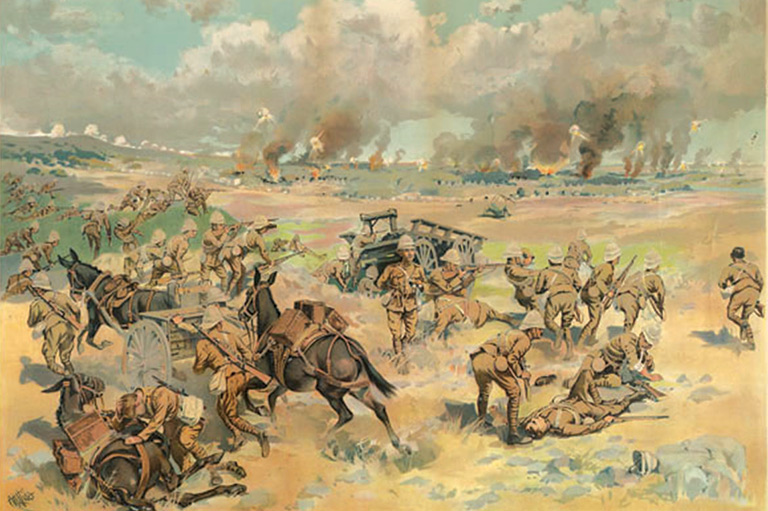
Born in Guelph, Ontario, McCrae joined the Guelph Highland Cadet Corps as a teenager. While studying at the University of Toronto, he continued his military involvement as a member of the Queen’s Own Rifles militia regiment. He graduated from medical school in 1898 but put his career as a doctor on hold when Britain went to war in South Africa in 1899. Although the colonial war was controversial in Canada, McCrae believed in the British Empire and volunteered as a gunner in the Royal Canadian Field Artillery from December 1899 to January 1901.
After studying in the U.S., McCrae began his medical career in Montreal, where he worked at several hospitals and in private practice. An expert in pathology, he lectured at McGill University and at the University of Vermont in Burlington. He penned and published poetry and short stories, joined social and literary groups, and became a founding member of the University Club of Montreal.
When the First World War broke out, he enlisted as a medical officer. It was during the Second Battle of Ypres in the spring of 1915 that he penned “In Flanders Fields,” although the exact circumstances of its creation are unclear and have become the stuff of legend. Some accounts have him writing it on a dugout step, others inside the dressing station, still others at the grave of his friend Lieutenant Alexis Hannum Helmer, whose funeral McCrae had conducted. What is known is that the poem was first published, anonymously, in the December 8, 1915, edition of the British magazine Punch. It quickly became so popular that it was reprinted, translated, and recited around the globe. McCrae was later identified as the author and became famous throughout the English-speaking world.
Both a reflection on death and a call to arms, “In Flanders Fields” was used to sell war bonds, recruit soldiers, and commemorate the fallen. It enshrined the poppy as a symbol of grief and loss, especially in the context of war. The poem remains a traditional part of Canadian Remembrance Day services. — Kate Jaimet
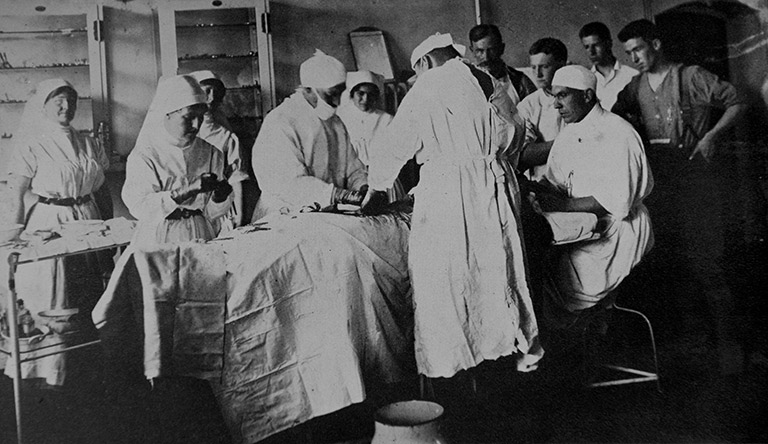
Captain Lawrence J. Rhea was an experienced pathologist who conducted hundreds of autopsies on slain soldiers at the No. 3 Canadian General Hospital, opening up their bodies to investigate the devastating effects of metal on bone, muscle, and organs. “We have held a post mortem examination on most of the cases that have died in the wards of this unit,” Rhea reported in the Canadian Medical Association Journal.
Rhea and other scientist-physicians noted life-saving surgical techniques and tactics to combat infection, and they made recommendations to improve patients’ care, treatment, and protection. In one early 1916 study, Rhea removed the brains of fourteen soldiers who had died as a result of shell fragments, concluding that steel helmets would have saved lives. Canadian soldiers were issued steel helmets beginning in April 1916.
While this dissection of the soldiers’ slain bodies was important to the medical war, Canadian and British doctors went one shocking step further. In a desire to learn from the dead, doctors harvested soldiers’ body parts — including brains, lungs, and other organs — to be used as teaching tools. While there was no concept of consent at the time, the soldiers’ next of kin were not told that their loved ones had body parts removed and sent to the Royal College of Surgeons in London, England, to be put on display.
McGill professor George Adami — who served as a colonel with the Canadian Army Medical Corps and was occasionally attached to No. 3 General Hospital — was very keen to have soldiers’ body parts preserved in Canada. He used his considerable influence to ensure that hundreds of body parts were sent back to McGill University during and after the war.
This disturbing practice was part of the medical learning process, and yet it clashed violently with the commemorative impulse after the war to build memorials to the fallen soldiers. As the words “lest we forget” were invoked time and time again — and as thousands of memorials were built across the country and cemeteries were created for the fallen overseas — McGill University students were learning to become doctors by using harvested soldiers’ body parts. This continued until the late 1950s, when the soldiers’ remaining organs were unceremoniously destroyed.
More information on the harvesting of soldiers’ body parts by medical practitioners during the Great War can be found in my book Lifesavers and Body Snatchers. — Tim Cook
We hope you will help us continue to share fascinating stories about Canada’s past.
We highlight our nation’s diverse past by telling stories that illuminate the people, places, and events that unite us as Canadians, and by making those stories accessible to everyone through our free online content.
Canada’s History is a registered charity that depends on contributions from readers like you to share inspiring and informative stories with students and citizens of all ages — award-winning stories written by Canada’s top historians, authors, journalists, and history enthusiasts.
Any amount helps, or better yet, start a monthly donation today. Your support makes all the difference. Thank you!
Advertisement