Your history. Your inbox.
7 uniquely curated newsletters to choose from.


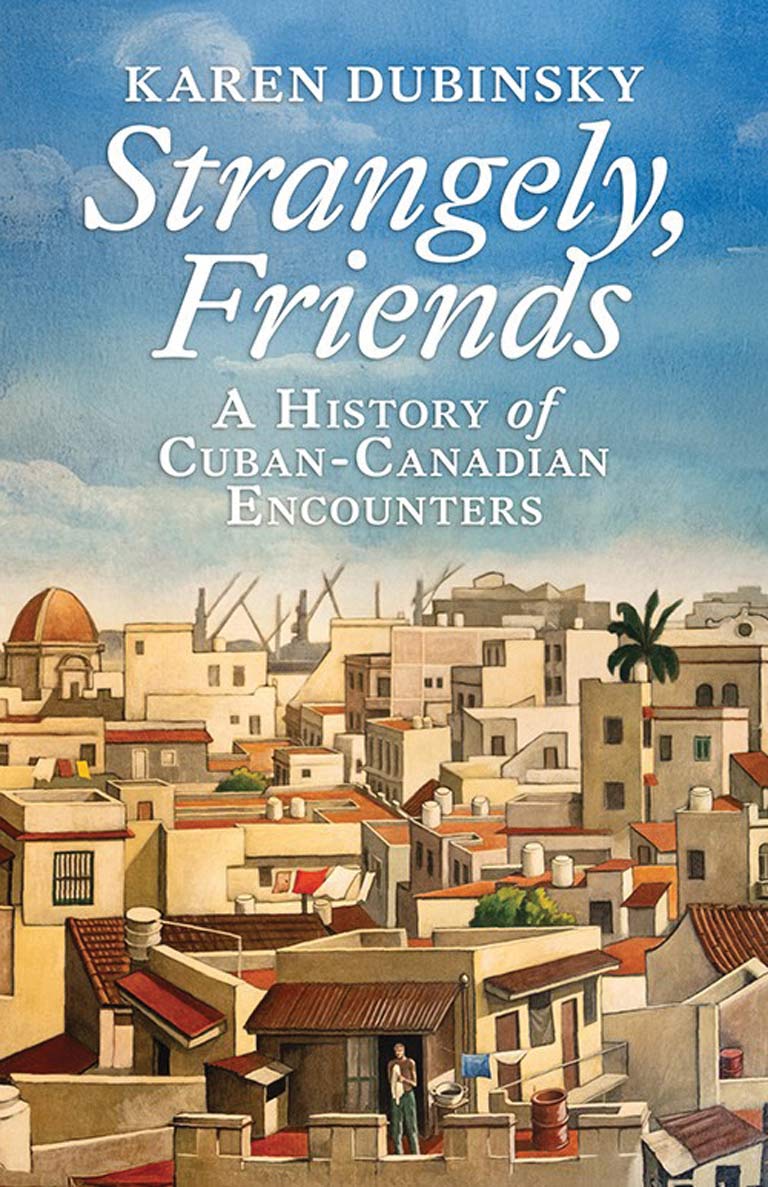
Strangely, Friends: A History of Cuban-Canadian Encounters
Written by Karen Dubinsky
Between the Lines
294 pages, $29.95
As I was reading the last few pages of Karen Dubinsky’s new book, Strangely, Friends, the UN General Assembly voted overwhelmingly, for the 33rd consecutive year, to condemn the United States’ embargo on Cuba.
While the U.S. has maintained its economic blockade since 1960 — and hardened that chokehold most recently in 2017 and 2025, under the Trump administration — Canada has, to the chagrin of its neighbour, continued diplomatic and trade relations with Cuba since its 1959 revolution. (There was even that time in 1976, when Prime Minister Pierre Trudeau famously gave the States a symbolic middle finger by meeting with Cuban President Fidel Castro on an official state visit.) Dubinsky doesn’t dwell on those events, or on top-level Canada-Cuba interactions, because her book is about “how citizens of different nations come to know each other through informal encounters, relations that are shaped, but not determined, by state policies.”
Review continues below...

With 7 uniquely curated newsletters to choose from, we have something for everyone.
And that’s what makes this story about Cuba refreshing. It’s a lovely portrait of human relationships built on solidarity and mutual respect. To peel back the curtain hung by headline-grabbing politicos with an agenda, Dubinsky, a historian at Queen’s University in Kingston, Ont., interviewed nearly 150 ordinary and extraordinary Cubans and Canadians, which allowed her to reveal layers of the two countries not otherwise easily discernible amid the propagandist din on both sides. She provides a series of portraits that depict the everyday life of Cubans in Canada and Canadians in Cuba — from scientists to teachers to musicians to artists — and how they have forged and strengthened friendships, exchanged ideas and knowledge.
By introducing us to such musicians as Jane Bunnett and Hilario Durán, and educators like Adrienne Hunter, who went to Cuba as an ESL instructor in the early 1970s, Dubinsky shows that no matter where we are and what political systems we live with, humans are at the core the same — with dreams and hopes, creative drives and a will for peace, justice and togetherness.
Advertisement