Your history. Your inbox.
7 uniquely curated newsletters to choose from.


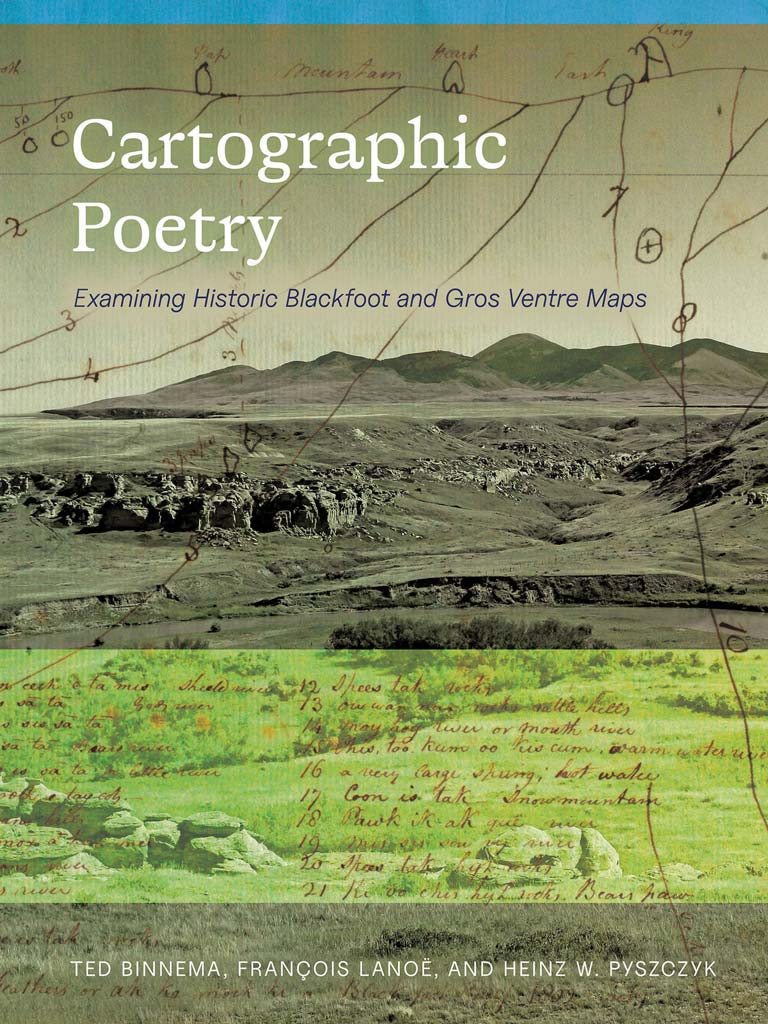
Cartographic Poetry: Examining Historic Blackfoot and Gros Ventre Maps
Written by Ted Binnema, François Lanoë and Heinz W. Pyszczyk
University of Alberta Press
232 pages, $39.99
Cartographic Poetry asks readers to rethink how we understand mapping and cartography. Written by historian Ted Binnema, anthropologist François Lanoë and archaeologist Heinz W. Pyszczyk, the book approaches early 19th-century Indigenous maps not as flawed precursors to European cartography but as valuable works shaped by their own cultural contexts, purposes and knowledge systems, distinct from western conventions.
The authors examine five maps created by the Blackfoot and Gros Ventre nations of the North American prairies and foothills. These maps — originally collected and transcribed by Hudson’s Bay Company surveyor Peter Fidler, and preserved in the HBC archives — are among the few surviving written documents produced by those communities for HBC. Through archaeological, linguistic and historical analysis, Cartographic Poetry demonstrates how each map reflects a specific moment, intention and relationship, showing that cartography was a long-standing tradition in these territories.
The authors frame their interpretations by likening the maps to poetry. The maps are typically described as sparse or minimalist, but we learn that they’re, in fact, highly intentional and distill the northern plains landscape into essential lines, icons and patterns that function as mnemonic devices, intended to be explained orally. Attempts by western scholars to “correct” or reorient the maps, the authors argue, are unsatisfying because their makers didn’t share such conventions. Although Fidler took Indigenous cartography seriously, he still filtered it through European systems of cataloguing and preservation, creating an invaluable archive that also reveals a layer of colonial mediation. Well researched and thoughtfully produced, Cartographic Poetry is a valuable resource for anyone interested in Indigenous history, environmental history and the politics of knowledge-making. It ultimately invites readers to challenge European frameworks and reconsider how cartography itself can be understood.

With 7 uniquely curated newsletters to choose from, we have something for everyone.
We hope you’ll help us continue to share fascinating stories about Canada’s past by making a donation to Canada’s History Society today.
We highlight our nation’s diverse past by telling stories that illuminate the people, places, and events that unite us as Canadians, and by making those stories accessible to everyone through our free online content.
We are a registered charity that depends on contributions from readers like you to share inspiring and informative stories with students and citizens of all ages — award-winning stories written by Canada’s top historians, authors, journalists, and history enthusiasts.
Any amount helps, or better yet, start a monthly donation today. Your support makes all the difference. Thank you!
Advertisement