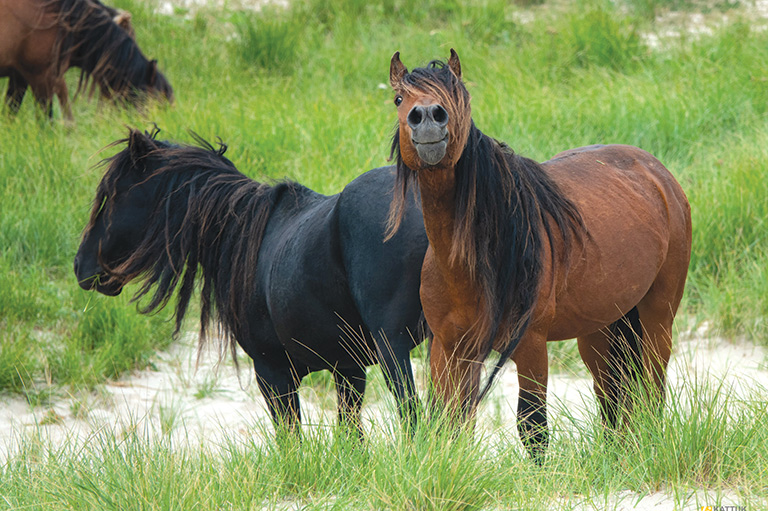
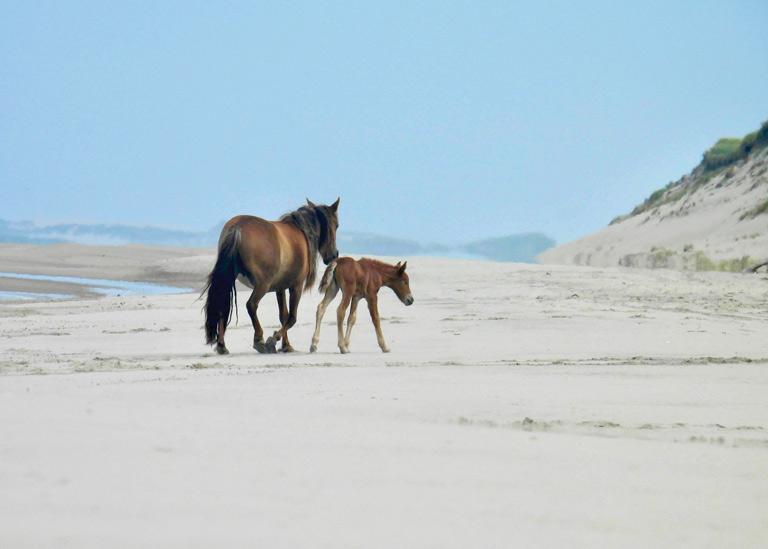
Like all good mysteries, no one knows just how horses wound up on a crescent-shaped sandbar in the Atlantic Ocean southeast of Halifax. People once believed the first horses escaped shipwrecks; now, the prevailing theory is that Boston merchant Thomas Hancock took most of them there to graze in 1760 after seizing them from the Acadians being deported from Nova Scotia.
Whatever the origin story, the 400 or so horses that now call Sable Island National Park Reserve home are considered a wild population of a naturalized species; they live without human interference and survive mainly on marram grass. The horses may be the biggest draw for the lucky few day trippers each year — but they’re not the only thing to see. “As you can imagine, this place is so fascinating that it attracts so many people,” says Parks Canada operations coordinator Kristina Penn. She is speaking during a welcome briefing at what is called Main Station, a building complex created by the Meteorological Service of Canada. Yet, access to Sable Island is tightly controlled to help preserve its delicate ecosystem, with only about 300 to 700 visitors permitted each year.

Your history. Your inbox.
With 7 uniquely curated newsletters to choose from, we have something for everyone.
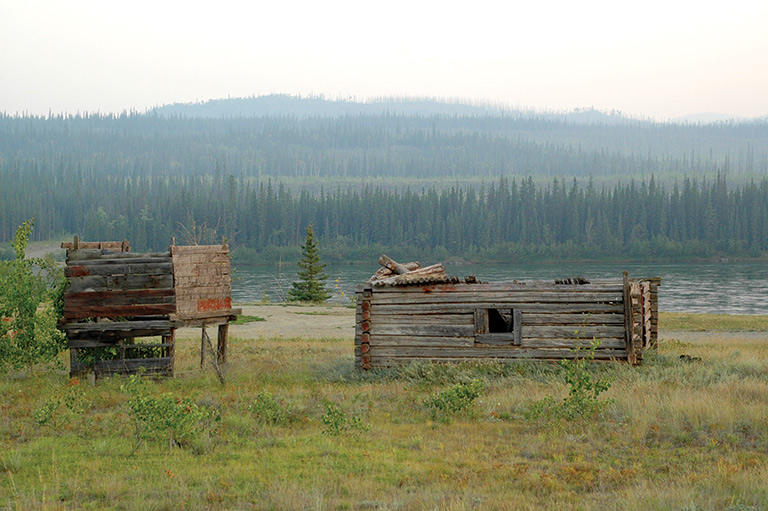
Explorers, scavengers, hunters, fishers, entrepreneurs and tourists have long been drawn to this vegetated sandbar that’s about 42 kilometres long and just 1.3 kilometres at its widest point. Look beyond the horses — and seals and birds — and you may see bits of shipwrecks, pipe racks from a drill rig staging area, fishing floats, historic buildings, war-era treasures dating back four centuries.
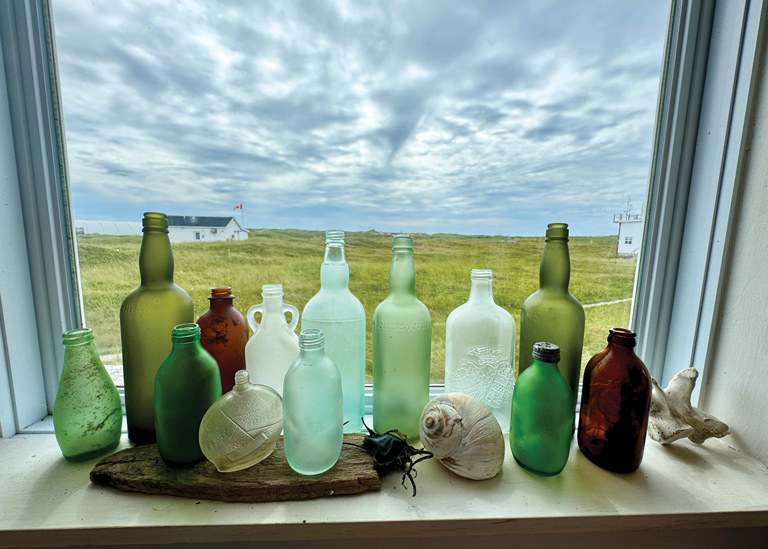
“Everything on Sable is a cultural artifact, so don’t collect any sand or bottles,” Kattuk Expeditions director Fred Stillman warns our group of seven visitors.
Portuguese explorers were the first documented human visitors to Sable Island in the early 16th century. After that came failed attempts to settle the island and seasonal occupations by shipwreck salvagers known as “wreckers.” But there has been continuous human presence on Sable since 1801.
Sable lies within rich fishing grounds and near a major shipping route between Europe and North America. Home to more than 350 recorded shipwrecks, it’s known as the “Graveyard of the Atlantic.” Sable became a national park reserve in 2013, and while up to six Parks Canada staff live on the island year-round, that number swells with visiting researchers.
On one beach near a lone harbour seal, we examine some vintage wood. “This has those wooden pegs in it, so I’d say it’s a gunwale — or it could be a hull piece,” says Stillman. “There’s always something interesting that you haven’t seen before.”
There are also fascinating things to learn, which a binder of facts compiled by Parks Canada reveals. Did you know, for example, that the life-saving stations on Sable Island to help shipwreck victims and reclaim precious cargo? Or that during the War of 1812, the American government forbade any interference in Sable’s operations because of its role in marine life protection?
The binder’s “historic buildings/life” section details how people were taken to Sable Island against their will: France once tried to establish a colony using prisoners; one life-saving station superintendent took bribes from people who wanted to banish family members to an illegal asylum, and the last superintendent staffed the island with youth from Cape Breton schools for troubled boys.
Beyond the binder, an artifact cabinet displays a 200-year-old metal house number, a walrus tusk, a seal skull and a net-encased glass fishing float, as well as a glass milk bottle that speaks to a time when farm animals were part of life on the island. If you stumble upon new objects during your explorations, you can admire and photograph them, but you must share coordinates with Parks Canada if they seem significant.
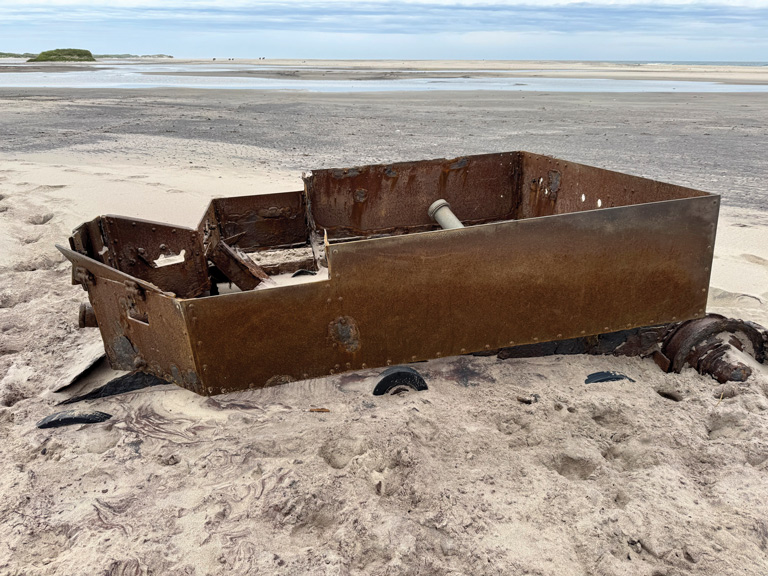
Strolling one final beach, we linger by what’s left of a Bren gun carrier, partially buried in the sand. Made by Ford Motor Company in the 1940s and used for light defence and transport during the Second World War, it did time on Sable as military surplus before being abandoned. A group from the U.K. tried to retrieve it in recent years but gave up the plan after seeing photos of its fragile condition, which made transport overseas impractical.
It’s on South Beach, close to Mummichug Ponds, where the horses gather for fresh water, and not far from a decommissioned lighthouse where you can ponder the lesser-told story of all the people who have called this unusual island home.
IF YOU GO
GETTING THERE: Visitors usually reach Sable Island by helicopter, plane or boat (expedition cruise ships or a sailing charter). Kattuk Expeditions, one of the tour operators licensed by Parks Canada, offers day trips with Vision Air Services helicopter flights out of Halifax’s Stanfield International Airport. Kattuk also offers select winter trips during grey seal breeding season, alongside other licensed operators that provide seasonal visits to the island.
STAY: The Nova Scotia-inspired Muir hotel opened in 2021 as part of downtown Halifax’s new Queen’s Marque, a mixed-use waterfront district.
EAT AND DRINK: While in Queen’s Marque, don’t miss Mystic’s multi-course tasting experiences. Also stop into Peace by Chocolate, a shop founded by Syrian refugees.
EXPLORE: Sea-kayak tours around Halifax Harbour with Harbour Watercraft Tours & Adventures visit Georges Island National Historic Site, part of the Halifax Defence Complex.
Help share the true stories that make Canada strong and free
At Canada’s History, we highlight our nation’s past by telling stories that illuminate the people, places, and events that unite us as Canadians, while understanding that diverse past experiences can shape multiple perceptions of our history.
Canada’s History is a registered charity. Generous contributions from readers like you help us explore and celebrate Canada’s diverse stories and make them accessible to all through our free online content.
Please donate to Canada’s History today. Thank you!