Your history. Your inbox.
7 uniquely curated newsletters to choose from.


At about 6 a.m. on Aug. 3, 1962, four spherical objects passed over Don Lamb’s home in The Pas, Man.
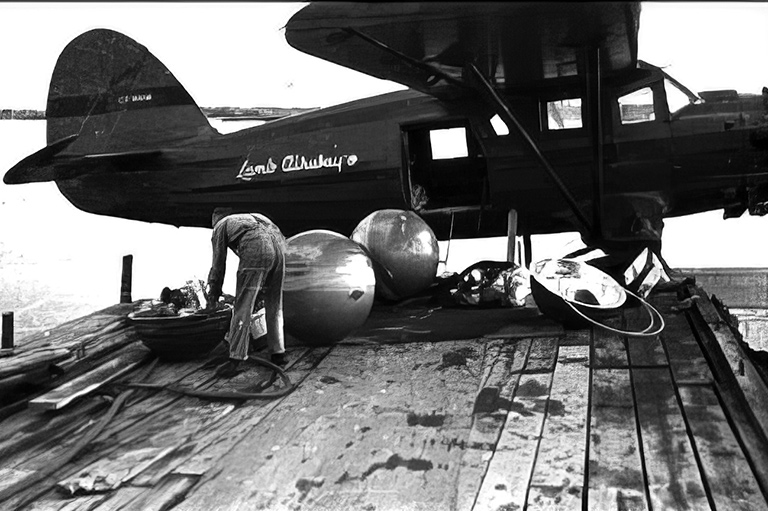
Lamb wasn’t dreaming. He was an eagle-eyed 29-year-old bush pilot — and he took off in pursuit. Flying his Norseman seaplane, Lamb followed the objects across the border toward north-central Saskatchewan. Once over Piprell Lake, near the boreal oasis of Candle Lake, the spheres began “falling fast,” reported a forestry worker, who radioed his strange sighting from atop a watchtower. Lamb landed nearby and raced through the lakeside wilderness.
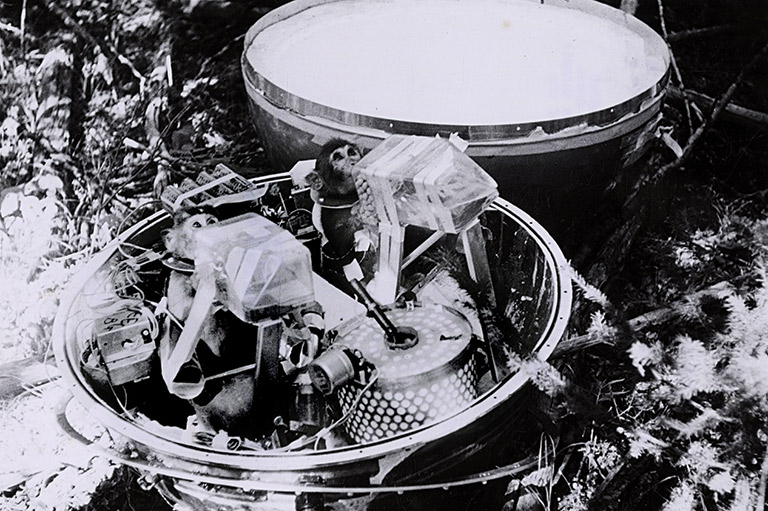
The four spheres were wedged in foliage, connected by a parachute. Each was grey and waist-high, but Lamb separated one from the rest. It had a lid, which the pilot hurriedly unscrewed. He looked inside. Two monkeys, sitting in a little cockpit, looked back. Those weren’t the first monkeys to fall on Western Canada that summer, nor were they the last, but they were the only ones found alive. Lamb rejoiced.
As did the NASA agents behind him. One small step for man took many giant leaps from animal-kind — and three jumps from a Lamb who, roused to recover skyfallen simians in remote Saskatchewan, became an unlikely shepherd for space travel.
Lamb’s mid-century monkey business culminated this past April in fellow Canuck Jeremy Hansen’s lunar flyby with Artemis II. How does the former beget the latter? Look to Artemis herself: Greco-Roman goddess of the moon, twin sister of Apollo and natural namesake for NASA’s long-awaited moon sequel. But buried below titles, and excavated from temples, are the animals sacrificed to Artemis for heavenly appeasement. Though appeasement changed to ascendance and superstition to science, ancient methods endured, making Don, and his flock, the only lambs who weren’t sacrificial.
Launched from a V-2 rocket in 1947, fruit flies were the first animals intentionally sent to space. Two years later, a rhesus monkey named Albert II became the first mammal — and primate — flung high above the stratosphere. He died on impact. His predecessor, Albert I, is thought to have perished before he left the ground.
Over the next 12 years, more monkeys — plus, mice, frogs, guinea pigs and dogs — unwillingly entered the cosmic crematorium. In January 1961, a chimpanzee called Ham survived his suborbital trip. He became the first hominid in space, setting the stage for Alan Shepard’s suborbital flight aboard Freedom 7.

With 7 uniquely curated newsletters to choose from, we have something for everyone.
Celebrating that success, American President John F. Kennedy pledged to put a man on the moon and return him safely to Earth, catalyzing the Apollo program and extensive tests for high- altitude hazards, especially radiation. NASA devised an experiment to see how cosmic rays — roughly half the strength of those that might mar moon men — affect various earthlings. Researchers gathered bacteria, fungi, seeds, nerve cells, viruses, flour beetles, Chinese hamsters and the Alberts’ heirs: rhesus monkeys, also called rhesus macaques, chosen for their sizable brains. Young-adult primates were implanted with cortical electrodes and tethered with a partner to tiny couches, their necks clamped to maximize exposure, in spherical fibre glass capsules about 90 centimetres in size that were under-shielded against radiation. Water and food pellets were placed within reach. The monkeys’ capsules were among other externally identical capsules containing recording devices and the smaller life forms.
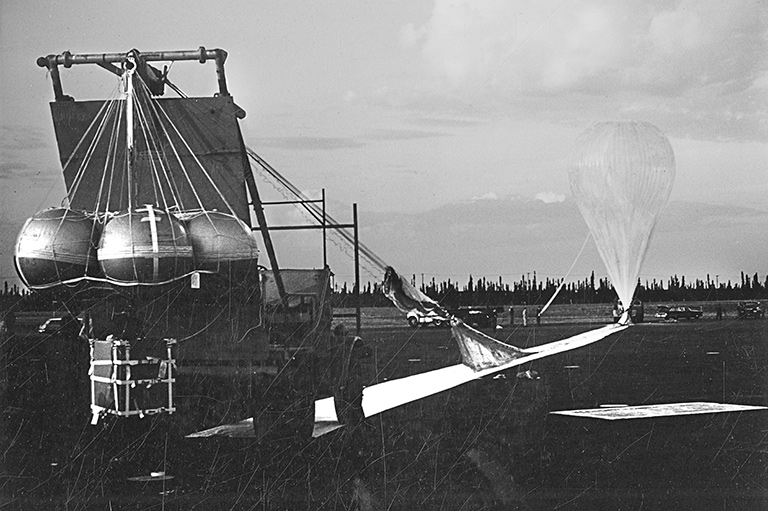
They were to launch from the Air Force base at Goose Bay, Labrador. The capsules would be suspended from a 117-metre helium balloon, which was to scale the stratosphere and catch westward winds for more than 3,000 kilometres along the 53rd parallel, crossing several Canadian provinces over a sparsely populated swath of North America. Once the balloon descended near Edmonton, its capsules would be remotely released and parachuted into the wilds, where a tracking plane would recover them.
NASA partnered with the likes of South Dakota based Raven Industries, which coordinated flights, and the University of California, which handled specimens. Its first launch of two monkeys, four hamsters and other organisms was from Goose Bay on July 14, 1962.
Don Lamb had no idea he’d be leading multiple monkey chases in preparation for lunar landings. Yet, shockingly, those may not have cracked the top 10 weirdest missions he and his family had tackled.
Sure, astro-monkeys were unprecedented, but the “Flying Lambs” — patriarch Tom and his six sons, all pilots for Lamb Airways — had flown everything from beavers to lynx to corpses for the only airline of its kind serving the Great White North.
Lamb Airways got tapped by Raven Industries on July 15, 1962. Rough weather necessitated the capsules’ release long before reaching Edmonton, so Lamb took off to help with recovery. After travelling for approximately 39 hours, the balloon released its payload over perplexed picnickers at Candle Lake. Lamb pontooned his plane and met specialists who arrived via helicopter. Together, they trudged through muskeg toward the drop zone, where all four hamsters and both monkeys were dead.
Radiation wasn’t the cause. Rather, NASA lead Webb Haymaker cited failure of the life-support system. Later reported in Aviation Week, this failure “allowed capsule temperature to rise above the survivable limits of the animals.”
While one article mentions an on-site burial, most sources say the bodies were flown out for further inspection alongside the yet-to-be- assessed specimens. It turned out that the flour beetles, numbered about 2,000, were thriving. Haymaker called the flight “90 per cent successful.”
After adjusting the life-support system, NASA launched more monkeys, hamsters, smaller organisms and recording equipment in four capsules from Goose Bay on Aug. 1, 1962. Again, Edmonton was the destination. And again, strong winds forced a premature drop near Candle Lake, requiring help from Lamb — plus his twin brother, Dennis, who ferried scientists with another aircraft to join Don at the drop site.
“They were really happy to see me when I took the lid off,” Don said to his wife, Beverly, of the simian survivors, according to Leland Stowe’s biography of Don, The Last Great Frontiersman. “Just glad for human company, I suppose.” The monkeys were so excited that “they even forgot to punch their slot machine for more food pellets.”
NASA recoverer Robert Schiffman said the monkeys were as healthy as he was. “In fact,” he added, “they are probably more rested.”
We hope you will help us continue to share fascinating stories about Canada’s past.
We highlight our nation’s diverse past by telling stories that illuminate the people, places, and events that unite us as Canadians, and by making those stories accessible to everyone through our free online content.
Canada’s History is a registered charity that depends on contributions from readers like you to share inspiring and informative stories with students and citizens of all ages — award-winning stories written by Canada’s top historians, authors, journalists, and history enthusiasts.
Any amount helps, or better yet, start a monthly donation today. Your support makes all the difference. Thank you!
The hamsters had also survived, but they couldn’t withstand the arduous recovery mission. Lamb and crew lugged the 200-kilogram payload through Saskatchewan’s woods and then flew it some 200 kilometres to their airbase near The Pas for transfer to a military craft destined for California. Before that exchange, however, Lamb made a detour that proved unforgettable for two future sky-climbers.
“My father loaded the capsule with the space monkeys into the back of a pickup truck and took them home to show them to us,” wrote Don and Beverley’s son, Todd, in an interview by email.
He was then just three years old, but Todd remembers he and his older sister, Meredith, standing on the sides of the truck to peer at the primates, who “were strapped into their seats with their heads secured so they couldn’t move.”
One macaque appeared lifeless, having ostensibly died during recovery, which seemed to have darkened its co-pilot’s demeanour.
“That space monkey looked so frightened. [Its] eyes were going back and forth trying to take everything in,” he wrote. “I remember my mother telling us not to get too close and not to touch them.”
Lamb returned the monkeys to his airbase and into NASA’s hands.
“As I got older,” Todd continued, “I couldn’t (and can’t) think about space travel without thinking of my father and those space monkeys.”
His father, in turn, wondered what became of the cosmacaques and if they were duly honoured for their celestial triumph.
Both monkeys were autopsied. Monkey A-2 went under the knife 92 hours after reaching altitude. Monkey A-1 survived six more months before dissection. Pathologists found lesions and other abnormalities across their brains, but, as published in Aerospace Medicine, “no conclusion could be reached whether any of the findings was attributable to thin downs of cosmic rays.” Still, as per unpublished preliminary data, such animals provided a “valuable baseline for estimations of general behavioral states” in space travellers, namely drowsiness, sleep, wakefulness and extreme alertness.
On Aug. 9, 1962, NASA launched its last living payload from Goose Bay. Two more monkeys and four more hamsters drifted 40 kilometres above Canada for dozens of hours. On Day 3, storms over Manitoba severed contact between the tracking plane and balloon. A jet stream may have worsened matters by propelling the vessel much farther than expected. NASA assumed its payload had dropped but couldn’t be sure. The balloon vanished near Gods Lake in the province’s northeast.
Lamb led an aerial search from northeastern Manitoba to northeastern Saskatchewan, while locals kept eyes on the ground for a red-and-white parachute. They looked for days, but the animals had food for just 70 hours and oxygen for 150 hours. Time ran out. The capsules were lost — their furry crew martyred for anthro-ascendance.
Following larger international launches with rats, cats and circumlunar tortoises, Kennedy’s hope was fulfilled as humans walked on the moon in 1969. More men made moon prints until 1972, when the Apollo program ended. It took 54 years for humans (including the first-ever Canadian) to re-enter lunar orbit via Artemis II. For all its sacrificial mythology, the Artemis program spurns animalian subjects, opting to test cosmic hazards on chip-borne, organ-mimicking human cells as a remarkable departure from space martyrdom and a possible death knell for animal testing in general.
Don, says his son Todd, simply “moved onto the next job” after the 1962 monkey business. He and his brothers manned monkey-less skies until Lamb Airways dissolved in 1981.
Todd Lamb managed airlines in Canada, China and Africa. Meredith Lamb applied to the Canadian Space Agency. Unable to orbit in life, she had her wish granted in death: on June 25, 2019, Meredith’s ashes rocketed into space.
If ever you find yourself in northern Manitoba or Saskatchewan and happen upon a cluster of spherical capsules trailed by an old worn parachute, give what remains of their passengers a proper send-off. Return them to soil, to land, to the earth only humans wish to leave.
Save as much as 40% off the cover price! 4 issues per year as low as $29.95. Available in print and digital. Tariff-exempt!
Advertisement