Your history. Your inbox.
7 uniquely curated newsletters to choose from.


Worldwide, there’s an abundance of spectacular landmarks that mark destinations on the map. They attract attention from residents and tourists alike and boldly reveal a locale’s soul, character and roots. More importantly, they also provide a lens into what their community values and how it is moving forward.
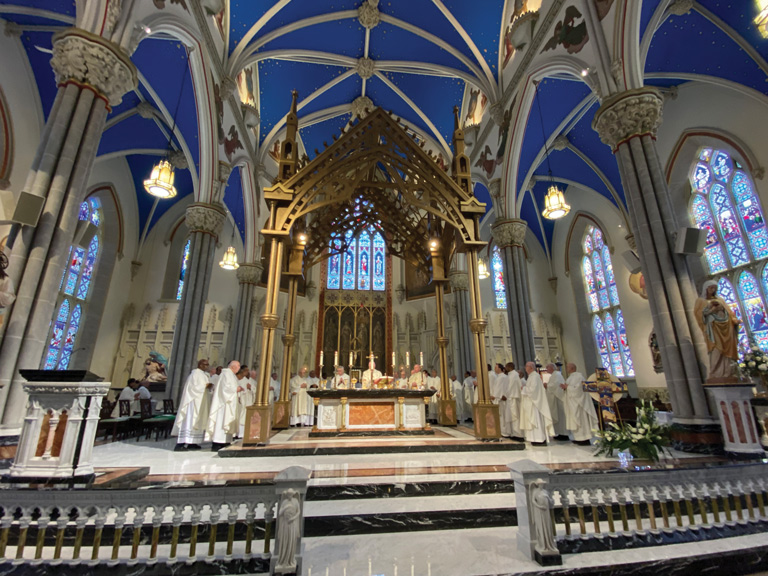
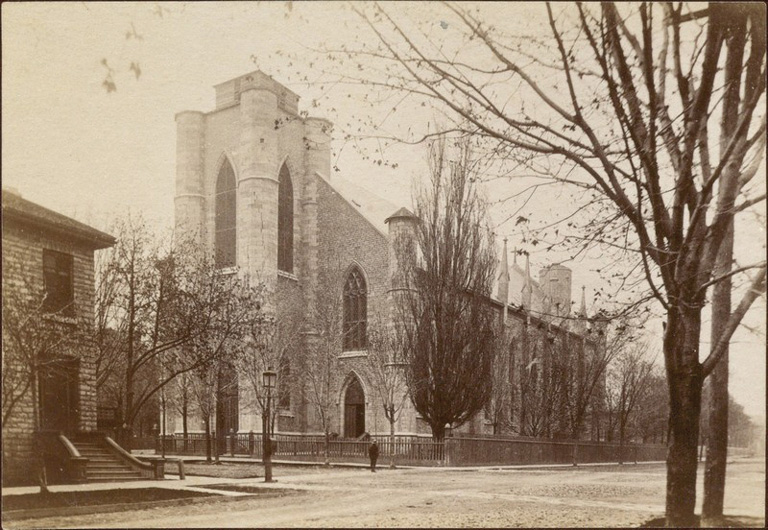
St. Mary of the Immaculate Conception, a Roman Catholic church that officially opened its doors in 1848 and towers over the city of Kingston, Ont., inherently carries this symbolic weight of awe and grandeur. With a soaring spire rising nearly 75 metres, the limestone Gothic revival cathedral has long been the city’s tallest structure. For almost two centuries, it has watched over what is affectionately known as the Limestone City, one of the nation’s most historic urban centres. With the ongoing renovations and restorations that began in February 2025, the parish’s many layered secrets are being unveiled for a new generation to discover.
Kingston, the unassuming cradle of Canada, was the pre-Confederation capital from 1841 to 1844 and home to our first prime minister, Sir John A. Macdonald. Architect James R. Bowes designed St. Mary’s Cathedral, which began construction in 1842 and was built amid the nation’s tumultuous beginnings.

With 7 uniquely curated newsletters to choose from, we have something for everyone.
Before 1816, “Roman Catholics in Kingston were baptized in the Anglican St. George’s Cathedral,” says Rodney Carter, an archivist with the Religious Hospitallers of St. Joseph. “French Canadians made up 37 per cent of the population of Kingston before 1840. The city’s demographics began to change, however, when an influx of Irish labourers arrived in the area to work on the construction of the Rideau Canal in 1827. This shift changed even more dramatically when the Irish immigrants fled the Great Famine in 1847 because it was the critical year for the ships of destitute Irish arriving in Kingston. By mid-century, over one-third of the population was Roman Catholic and mainly Irish.”
During that era, Kingston was dominated by antagonistic politics and sectarianism. The Orange Order, a Protestant fraternal organization founded in Ireland in 1795 and later established in Canada, was popular in the region. “The religious conflict occasionally erupted into violence, notably on the ‘Glorious Twelfth’ of July 1843,” explains Carter. “On that night, a mob of Orangemen attempted to assault Bishop Patrick Phelan and damaged the cathedral, which was under construction. Insults and then stones were thrown between groups of boys. Then, men with clubs, swords and firearms became involved. In the turmoil, a young man was fatally shot on the cathedral site. The military was called in to restore order.”
The cornerstone was laid on Sept. 8, 1843. Roughly 4,000 people attended — including non-Catholics — demonstrating interfaith support for peace. The church was completed and held its grand opening on Oct. 4, 1848. Over its almost 180 years, the cathedral’s interior and exterior have undergone various modifications.
Advertisement
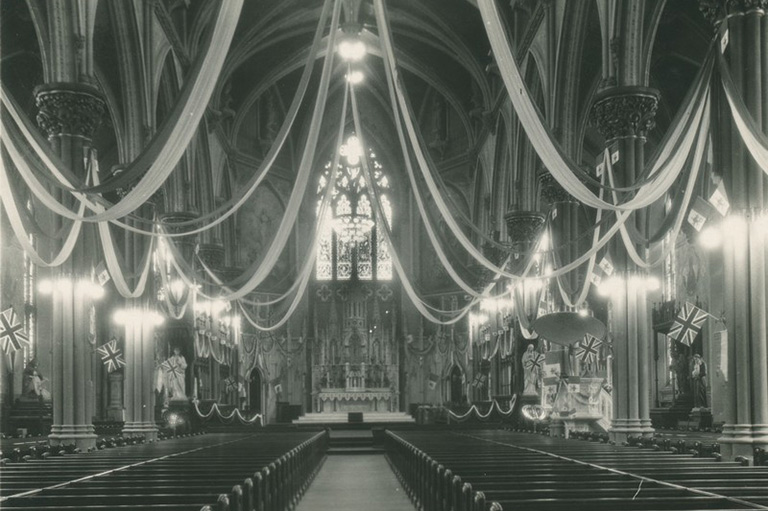
The structure’s interior is 64 metres long, nearly 27 metres wide and more than 27 metres high. When the cathedral first opened, although it had the same dimensions, it was significantly more austere in style and design. Then, in 1889, Joseph Connolly, a renowned architect, made eye-catching enhancements under the direction of Bishop Cleary, who went on to become the city’s first archbishop.
“Connolly altered the interior layout and installed the stained-glass windows, among other additions and embellishments," says Carter. "In 1889, construction of the three towers in front of the church began, replacing the original squat, square belfry, and in 1890, the St. James Chapel was added. There were renovations of the sanctuary in 1969, moving the altar forward and removing the altar rail and the pulpit, among other changes. A decade later, the walls and ceiling were painted a light colour and the decorative scheme simplified.” Additional structural renovations were completed between 1987 and 1995.
The project also revealed previously unknown historical elements
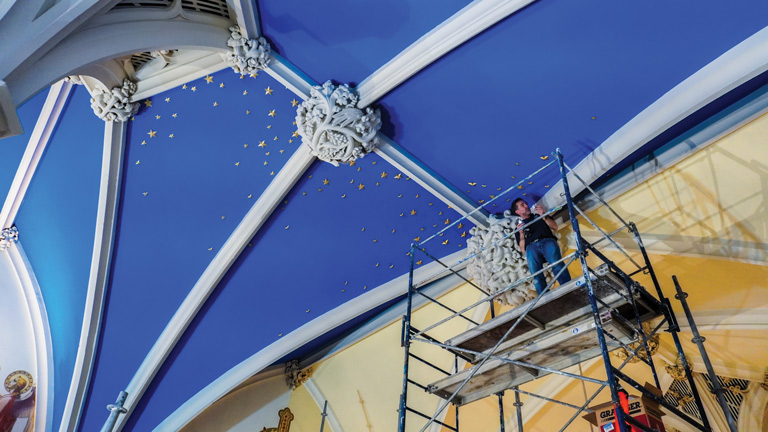
Today, under the expertise of Carlos Nunes, the founder and director of Fine Painting Design Restoration, the cathedral has been commissioned for an extensive renovation and restoration to coincide with the Archdiocese of Kingston’s 200th anniversary in 2026. The project launched in February 2025 and was set to proceed in three phases: the sanctuary, the nave and the narthex, which will also include the exterior. Although the first two phases are complete, the process will extend well beyond five years.
The project’s main objectives have centred on adding three large structures to refine the sanctuary, potentially one of the largest in Ontario. The mandate is to build a ciborium, construct a communal rail for parishioners to receive the host and divide the sanctuary into three parts; these include a central sanctuary and two independent devotional sections dedicated to prayer. Freshening up the colour scheme and improving the lighting system are also priorities.
Save as much as 40% off the cover price! 4 issues per year as low as $29.95. Available in print and digital. Tariff-exempt!
Nunes and his team have had to balance reintroducing traditional elements while also preserving them. Materials such as wood, organic oil paints, waxes, gels, resins and native marble species that were popular when the cathedral was constructed, and currently in short supply, were all used thoughtfully to respect the integrity of the original artistry. The team has employed modern techniques, but the balancing act is crucial.
“The skill sets of master craftsmen are harder to come by and costs have ballooned,” says Nunes. “We had to create moulds of individual architectural pieces and replicate with resins, where before it was all hand-carved and painstakingly taken from marble. We’ve had to replicate a great deal, but we’re doing it from a source of truth and originality.”
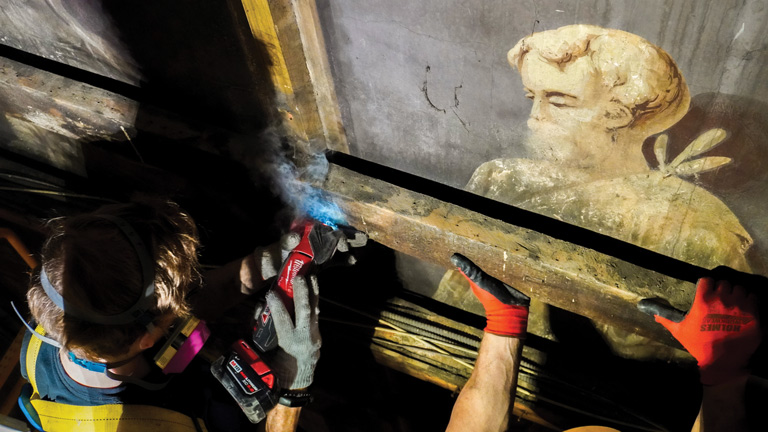
The project also revealed previously unknown historical elements. Among them is a stunning monochromatic fresco from the 1870s depicting four prominent religious figures: St. Patrick, St. Bridget, St. Mary and St. Joseph.
St. Patrick and St. Bridget highlight the significance of the Irish community in Kingston at the time the cathedral was built. Each figure stands on a separate pillar, overlooking the sanctuary. The mural, last exposed around 1910, was concealed by a marble altar. Nunes and his team unexpectedly uncovered and then restored the masterpiece.
“The fresco was protected and hidden like a time capsule. It was really meaningful,” says Nunes. “It altered the course of what we initially had in mind as a design. The building’s structure held secrets to guide us, so we listened.”
Another surprise was the discovery of a series of limestone crosses buried in the walls of the church’s interior. The crosses date back to the cathedral’s initial construction and were used to consecrate and bless the site, says Nunes. They were placed in alignment with the 14 stations of the cross, but Nunes and his team found just 10. As a symbolic homage, Nunes replicated the missing crosses, added candles and re-displayed them in their original locations. The candles were lit during the Archdiocese of Kingston’s 200th-anniversary kickoff mass and celebration, held in December 2025.
When it comes to the restoration influencing not only today’s parishioners but also future generations’ connection to the cathedral, the Most Rev. Michael Mulhall, Archbishop of Kingston, looks forward with optimism. “The church is the centre of the spiritual life of members of the parish. We hope that the restorations elevate their attachment to their devotions while in the cathedral,” he says. “I hope all generations, young and aged, find peace and joy when they spend time in St. Mary’s Cathedral.
We hope you will help us continue to share fascinating stories about Canada’s past.
We highlight our nation’s diverse past by telling stories that illuminate the people, places, and events that unite us as Canadians, and by making those stories accessible to everyone through our free online content.
Canada’s History is a registered charity that depends on contributions from readers like you to share inspiring and informative stories with students and citizens of all ages — award-winning stories written by Canada’s top historians, authors, journalists, and history enthusiasts.
Any amount helps, or better yet, start a monthly donation today. Your support makes all the difference. Thank you!
Advertisement