Your history. Your inbox.
7 uniquely curated newsletters to choose from.


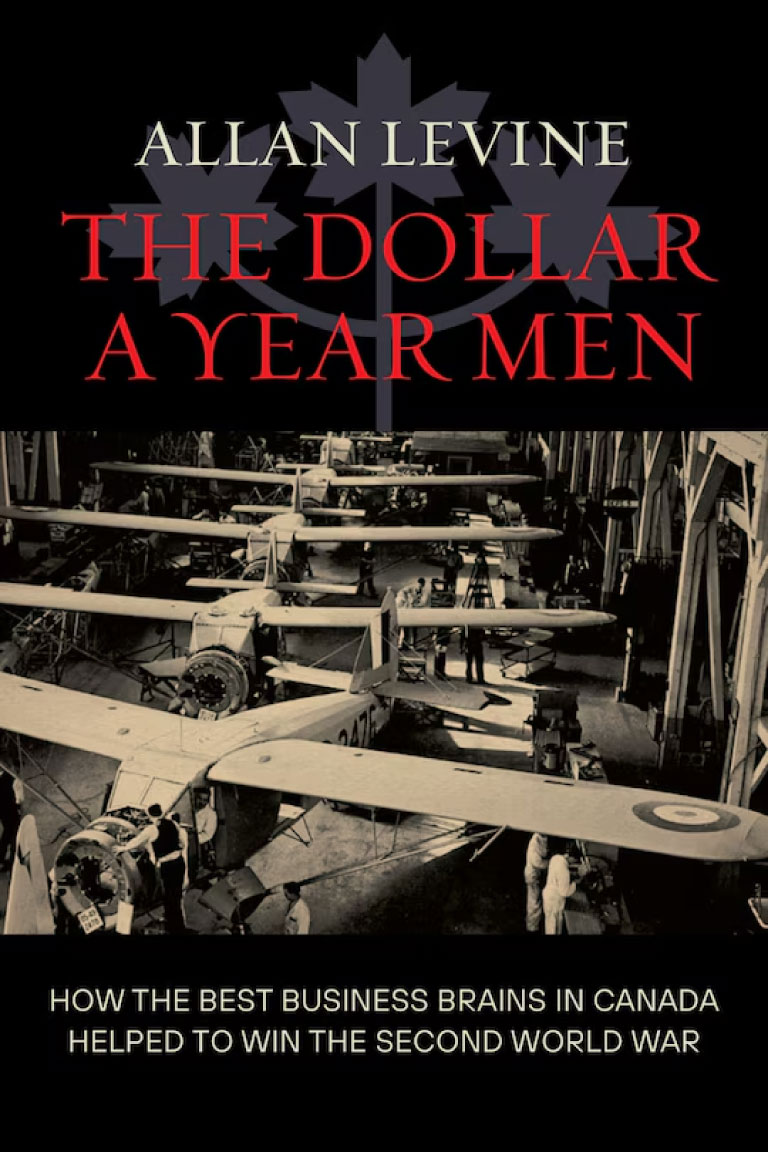
The Dollar a Year Men: How the Best Business Brains in Canada Helped to Win the Second World War
Written by Allan Levine
Barlow Books
400 pages, $42
Timing is everything, and Allan Levine has hit the bull’s-eye with his account of how business leaders were recruited to Ottawa to assist the massive government effort that supported Canada and its Allies during the Second World War. The country’s leaders faced an immense challenge. They had to acquire and produce equipment for rapidly expanding Canadian forces, support Britain when its own production fell short and build an industrial system capable of manufacturing aircraft, ships, vehicles and weapons. In doing so, they transformed the Canadian economy. Levine, a respected Winnipeg-based author, draws on archival and published sources to tell this complex story with clarity and depth in an engaging and accessible way.
In 1939, Canada was still largely rural and agricultural. By 1945, it had become an industrial power, with the world’s fourth-largest air force and navy, plus a well-equipped, battle-tested army. This transformation owed much to business, engineering and administrative leaders who left private industry to serve the public; those are the executives featured here. Some 800 specialized professionals served as “dollar-a-year men” (they were paid a symbolic $1 per year). Levine focuses on people in the Department of Munitions and Supply — led by the powerful and controversial C.D. Howe — showing who was recruited and from which companies, how they collaborated (or clashed) and how their skills contributed to the war effort. Levine also describes tensions with British and American leaders who, while needing Canadian production, sought to protect their own industrial dominance.
What mattered most was their sense of duty and their understanding of the fascist threat
Review continues below...

With 7 uniquely curated newsletters to choose from, we have something for everyone.
Dollar a Year Men resonates strongly today. Levine recounts the creation of joint defence production with the United States through the Ogdensburg and Hyde Park agreements. Prime Minister King worried that such arrangements might lead to America quietly absorbing Canada, even as he accepted the practical need for shared supply chains.
Levine avoids romanticizing the businessmen. Many, he notes, continued to receive full salaries from their companies. What mattered most, says Levine, was their sense of duty and their understanding of the fascist threat. “Without them,” he concludes, “surviving the ordeals of the Second World War would have been a lot more difficult.” Levine’s work also raises a contemporary question: Do we still have a reservoir of people willing to step forward in this way in a time of economic and sovereignty challenges?
Today’s business leaders are shaped by different education, citizenship and international company ties than the British-oriented elite of the 1930s. Even our military is now trained to operate mainly with American equipment and command structures. The book’s cover quotes former prime minister Jean Chrétien: “When Canada is under assault, good men and women step up to serve. That is what happened in World War Two. That is what is happening now.” Levine clearly hopes his book will inspire that same spirit again.
We hope you’ll help us continue to share fascinating stories about Canada’s past by making a donation to Canada’s History Society today.
We highlight our nation’s diverse past by telling stories that illuminate the people, places, and events that unite us as Canadians, and by making those stories accessible to everyone through our free online content.
We are a registered charity that depends on contributions from readers like you to share inspiring and informative stories with students and citizens of all ages — award-winning stories written by Canada’s top historians, authors, journalists, and history enthusiasts.
Any amount helps, or better yet, start a monthly donation today. Your support makes all the difference. Thank you!
Advertisement