Bilijk
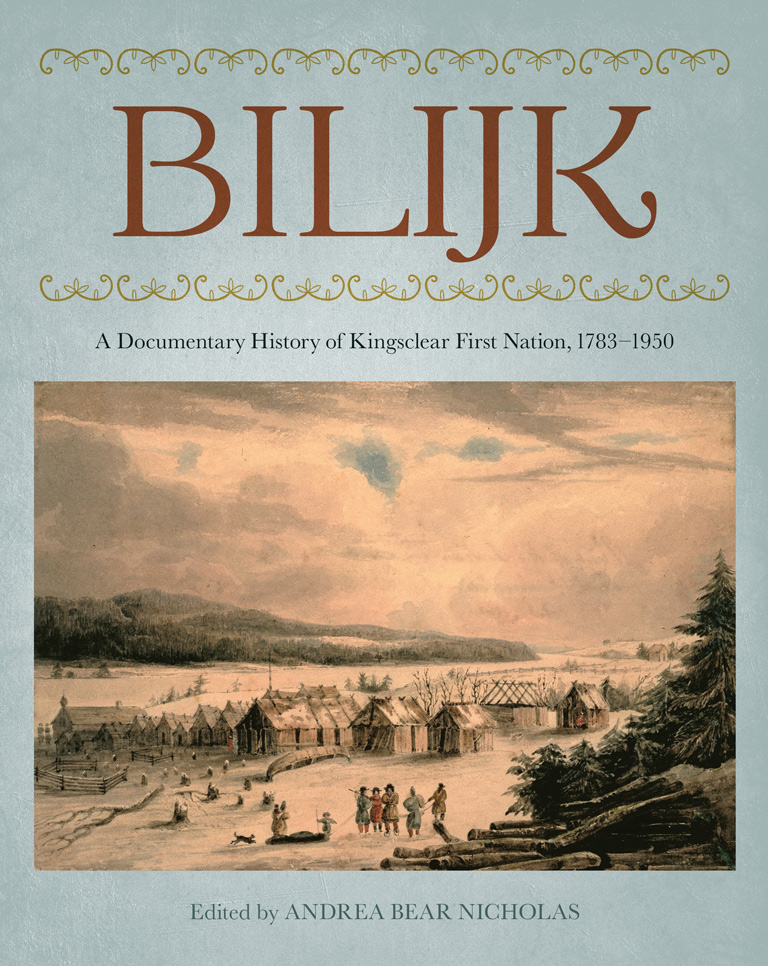
Bilijk: A Documentary History of the Kingsclear First Nation, 1783-1950
Edited by Andrea Bear Nicholas
Goose Lane Editions,
352 pages, $50
If you judge a book by its cover, the one I’m holding in my hand speaks of defiance. Its uppercase title, BILIJK — the W last kwey name for what in colonial terms came to be called Kingsclear First Nation — appears as a fist-in-the-air “We are still here.” Swaddled in the beauty of a Wabanaki double-curve motif, it anchors the book’s raison d’.êre: to offer a documentary history of the first Wəlastəkwey community to be established as a reserve in what we today call New Brunswick.
Researched and edited by historian Andrea Bear Nicholas — a Wəlastəkw — over a 20-year period, Bilijk rolls out a chronological account of the Wəlastəkewiyik and their struggle to stay alive, physically and culturally. The troubles covered in the book began after some 11,000 Loyalists flooded the area around Bilijk/Kingsclear during and after the American Revolution; they continue to this day.

With 7 uniquely curated newsletters to choose from, we have something for everyone.
Bear Nicholas, together with her now-late husband, Darryl Nicholas, gathered records and oral histories, including some that had never been shared before, that show how the past plays out as a genocide against the Wəlastəkewiyik. She lets the people who were there during the years she covers (1783-1950) — Wəlastəkewiyik (a.k.a. Maliseets), Loyalists, church and Crown representatives, Indian Agents, settlers and housewives — tell the story. By getting out of the way and relaying their words verbatim, Bear Nicholas has created a map that looks at uncomfortable truths.
As political philosopher Frantz Fanon has pointed out, colonizers have always worked to erase Indigenous Peoples’ past only to impose their own versions to suit their motives of greed. Bear Nicholas does the opposite. She flips the colonizer’s version of history by foregrounding written records, transcripts and accounts that have been omitted from the narrative. She shows us how colonial racism led to land theft, fraud, lies, murder, environmental degradation and other misdeeds. Bear Nicholas created the book primarily for young W last kokewiyik who have never been taught Maliseet history in school, but it’s as much for those of us who care about what it means to be Canadian. We owe it to Bear Nicholas and the Maliseet at Bilijk to read their version of what really happened — for they’re still here, in uppercase and in bold.
We hope you will help us continue to share fascinating stories about Canada’s past.
We highlight our nation’s diverse past by telling stories that illuminate the people, places, and events that unite us as Canadians, and by making those stories accessible to everyone through our free online content.
Canada’s History is a registered charity that depends on contributions from readers like you to share inspiring and informative stories with students and citizens of all ages — award-winning stories written by Canada’s top historians, authors, journalists, and history enthusiasts.
Any amount helps, or better yet, start a monthly donation today. Your support makes all the difference. Thank you!
Themes associated with this article
Advertisement