Your history. Your inbox.
7 uniquely curated newsletters to choose from.


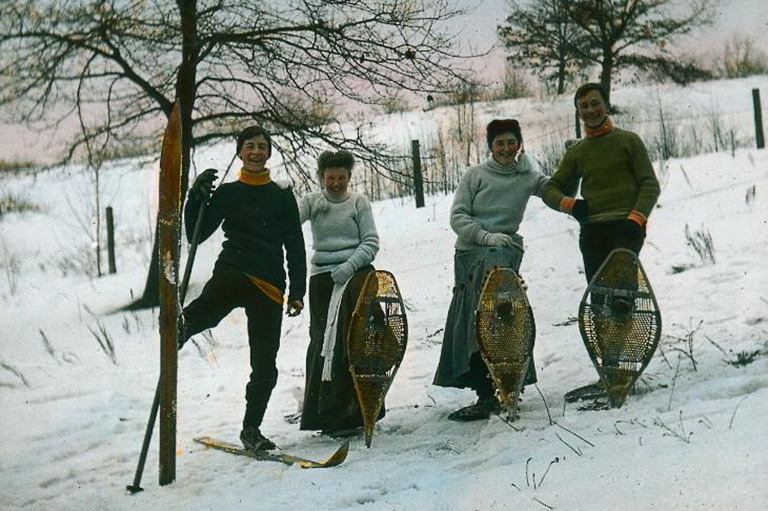
As much as many Canadians complain about the snow and cold of our winters, plenty also relish the seasonal opportunity to whip down a local hill on a toboggan, lace up for a skate with friends or strap on snowshoes for an enchanted and energetic hike in the woods. Every one of those cold-weather activities not only help us embrace winter but they also connect us to the generations past who invented and evolved them.
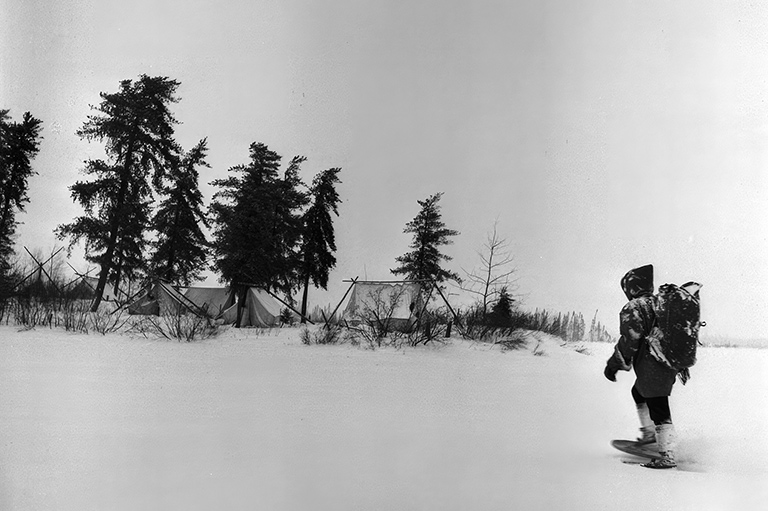
Few inventions did more to unlock Canada’s winter landscape than the snowshoe. For generations, Indigenous Peoples created and used them to move swiftly across deep snow, connecting communities, pursuing game and navigating a frozen world. Crafted from flexible ash or birch wood and intricately laced with rawhide, snowshoes were designed to distribute weight across the snow, allowing users to move efficiently and quietly. “Everybody had their own kind of snowshoe that would be well suited to a particular type of terrain. They could be big and long and wide or they could be really narrow and nimble,” says Janice Forsyth, a professor of Indigenous land-based physical culture and wellness at the University of British Columbia, and a member of the Fisher River Cree Nation.

With 7 uniquely curated newsletters to choose from, we have something for everyone.
Fur traders, voyageurs and early settlers, seeing how indispensable snowshoes were, quickly adopted them. Soldiers did, too. In February 1813, the 104th Regiment of Foot — an infantry regiment that included Black enlistees — began a 1,100-kilometre march from New Brunswick to Kingston, Ont., by snowshoe so they could fight in the War of 1812.
As industrialization grew in the 1800s, snowshoeing emerged as a popular sport. “Snowshoeing was the first Indigenous activity to be taken up by British colonists,” writes Gillian Poulter in her book Becoming Native in a Foreign Land. “Snowshoeing began as an organized sport in 1840, when a group of 12 young Montrealers began meeting together on Saturday afternoons to tie on snowshoes for a 10- or 12-mile tramp in the environs of the city.”
Competitive races soon followed, but Poulter notes that while Indigenous participants were included in the early years, racism eventually pushed them out. “For instance, at the 1873 Maple Leaf Snow Shoe Club races [in Montreal], the white contestants protested when a race was won by Peter Thomas, a native snowshoer,” she writes. “The protest was decided in favour of Thomas since the race had been advertised as ‘open,’ although the race organizers had intended this to mean open to members of other clubs. Thomas had challenged this by entering the race, and the principle of fair play overrode racism in this case.” Soon thereafter, however, the Montreal Pedestrian Club, which also included snowshoeing, changed its rules to disqualify Indigenous participants.
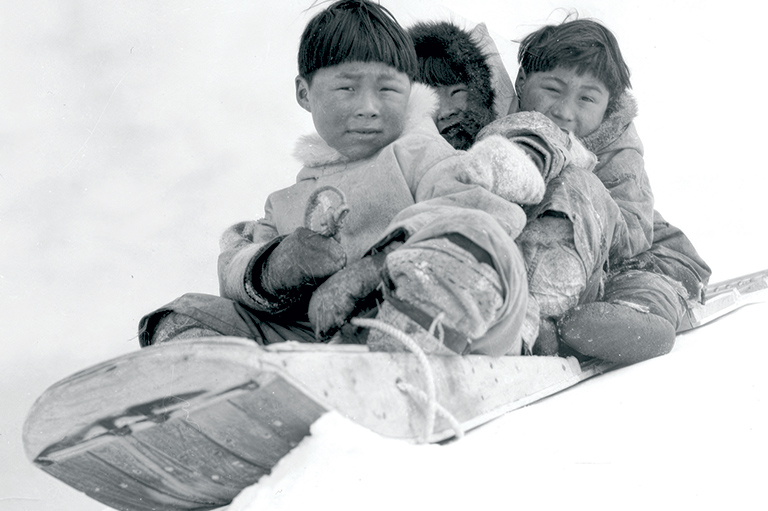
For thousands of years, Indigenous Peoples across what’s now Canada relied on toboggans to move across snow-covered landscapes. People on snowshoes pulled the sleds, which were often long and flat with a curved front and made with bentwood and animal skins. Like other Indigenous innovations, writes Poulter, European settlers, who began to arrive in the 1600s, co-opted tobogganing. It was an essential tool for the fur trade and eventually evolved into an exciting way to enjoy snowy weather.
“In the effort to bring a British sense of order and regulation to colonial society, tobogganing, like snowshoeing and lacrosse, was ‘tamed’ by being organized into a middle-class club sport that was carried out in a specific location and subject to particular behaviour and technological ‘improvements.’ In the process its history was appropriated,” explains Poulter.
Tobogganing surged in popularity in the 19th century, and cities across Canada constructed dedicated slides and runs. Most have long since disappeared and Canadians must now rely on hills and coulees for their sledding fix. However, Quebec City’s iconic Dufferin Terrace slide, built in 1884, continues to thrill riders with speeds approaching 70 kilometres per hour.
Advertisement
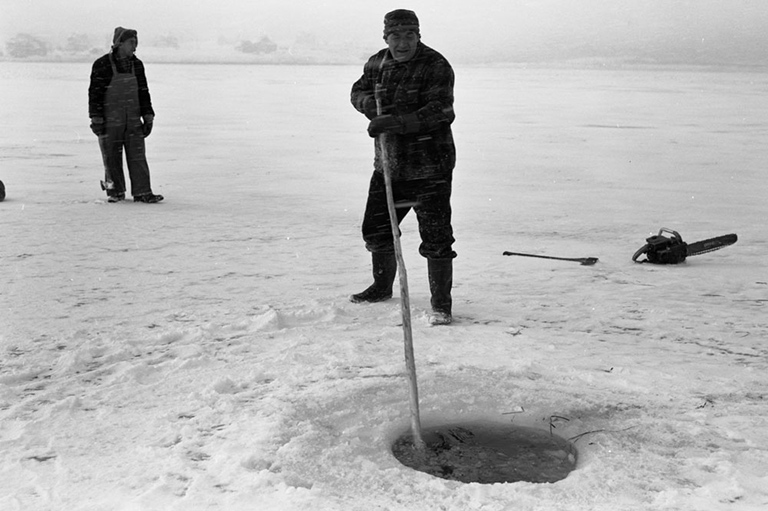
Like snowshoeing and tobogganing, ice fishing was a survival skill practised and developed by Indigenous communities across Turtle Island. Depending on the geography and available resources, “they would have had different methods, whether it was gillnets [made from cedar bark or nettles] or spearfishing or some sort of line with a hook,” says Forsyth. “People were very inventive in terms of how they would catch the fish.”
The Ojibwa of northwestern Ontario, for example, used tools made from bone or stone, cut holes in the ice and caught fish with spears, often attracting them with wooden decoys or bait. Knowledge of fish behaviour, safe ice conditions and seasonal changes were passed down through generations, with families and communities sharing both the work and the catch.
By the late 1800s, government regulations had begun restricting Indigenous fishing rights. For instance, in British Columbia, Indigenous fishers were required to obtain government licences even to fish for food, part of a series of regulations that hindered their access to fisheries.
While government policies disrupted Indigenous fishing practices, they didn’t erase them; and this disruption didn’t stop Indigenous Peoples from helping inspire a recreational pastime enjoyed by Canadians from coast to coast to coast.
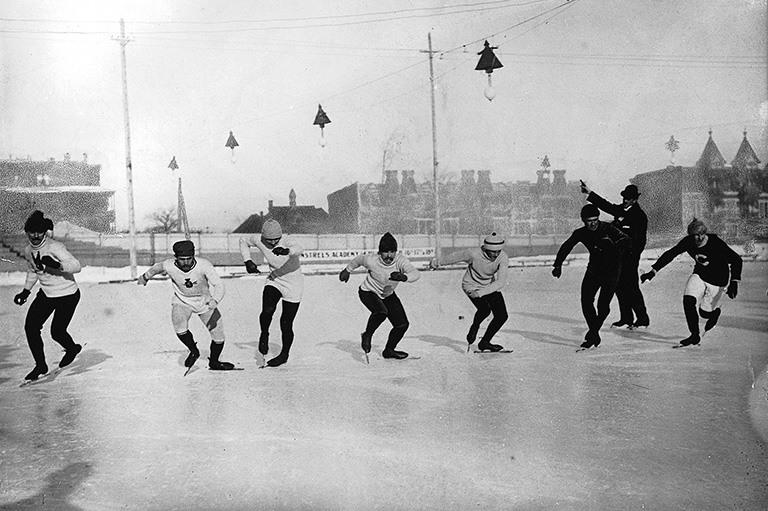
The earliest ice skates were simply metal blades strapped to boots, which were notoriously awkward and easily fell off. As a remedy, the blades were sometimes screwed onto the boots. In 1866, Starr Manufacturing Company of Dartmouth, N.S., patented the Acme Spring Skate, which fastened to the boot with a springloaded locking mechanism, offering a secure fit and saving perfectly good boots from ruin.
At its peak, the company employed 250 workers and produced more than 100 pairs daily. Its success faded, though, after the original patent expired in 1873, allowing competitors to flood the market with cheaper imitations. By the 1920s, Starr was struggling against foreign imports and such local rivals as CCM. The Great Depression delivered the final blow, and the company closed its skate division in 1939.
But, of course, our country’s passion for ice-skating endures, with Ottawa’s Rideau Canal boasting the world’s largest skating rink. Our landscape features 4,275 outdoor rinks and 2,569 indoor ones as of 2020.
Save as much as 40% off the cover price! 4 issues per year as low as $29.95. Available in print and digital. Tariff-exempt!
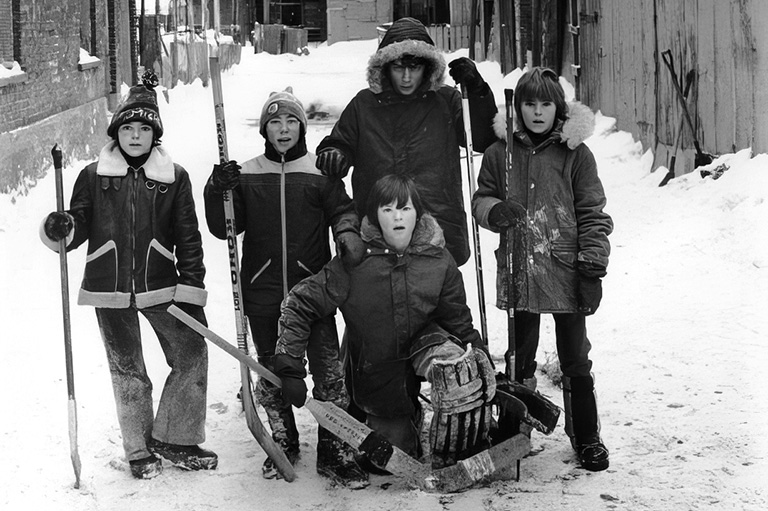
The emergence of Canada’s favourite sport was sort of inevitable. “We know from really early research that pretty much every culture in the world had a ball-and-stick game, and those that experienced winters where the ice freezes over and there’s snow, they played some form of what we might call hockey,” says Forsyth. In fact, she points out, long before modern hockey took shape in the 19th century, the Mi’kmaq and other First Nations were playing games that had similarities to Canada’s beloved pastime. It’s a legacy Forsyth says should be further explored and acknowledged.
Debate over ice hockey’s origins continues to this day. While many sources — including the International Ice Hockey Federation — maintain that the first organized game was played in Montreal in 1875 and that the sport’s first published rules appeared in the Montreal Gazette in 1877, other research points to earlier organized games played on skates in England.
One thing we can say for sure is Canada played a pivotal role in the sport’s evolution. From the 1870s onward, Canadians refined the game, and by the early 20th century, “Canadian rules” had become the foundation of modern ice hockey. That influence included equipment, epitomized on Nov. 1, 1959, when Quebec-born Montreal Canadiens goaltender Jacques Plante became the first NHL goalie to regularly wear a fibreglass face mask. His decision revolutionized player safety and helped make facial protection standard equipment.
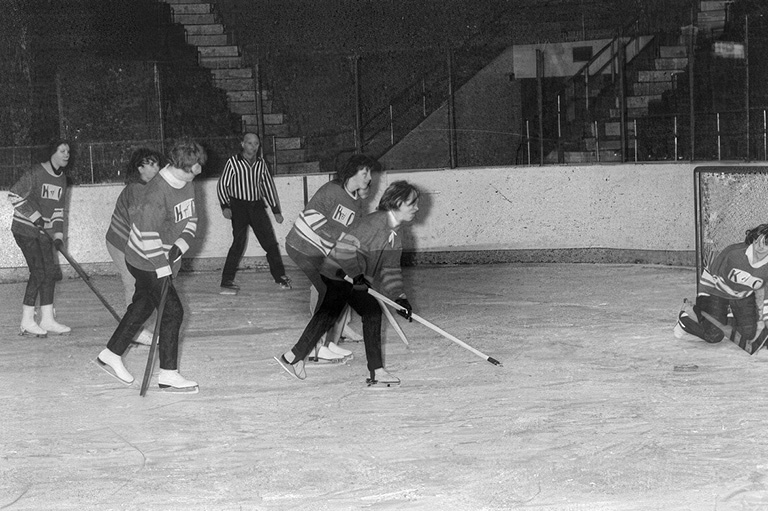
In 1963, Sam Jacks, the director of parks and recreation for North Bay, Ont., faced a quandary. He wanted to give women and girls more opportunities to be active in the winter months, so he set out to create an activity just for them.
Working with Red McCarthy, the recreation director for nearby Espanola, to develop the rules, Jacks designed a fast-moving game built around passing, teamwork and skating; he named it ringette, meaning “little ring,” referencing the “puck” used. Unlike hockey, players cannot carry the ring from end to end. “You have to pass; you have to engage everybody,” says Jenni Lloyd, the communications, engagement and marketing director at Ringette Canada.
The first organized game took place in the Espanola arena in the fall of 1963. Its popularity grew quickly, thanks in part to Jacks’s efforts to promote the game across the country, culminating in the founding of Ringette Canada in 1974. Today, more than 32,500 Canadians play ringette.
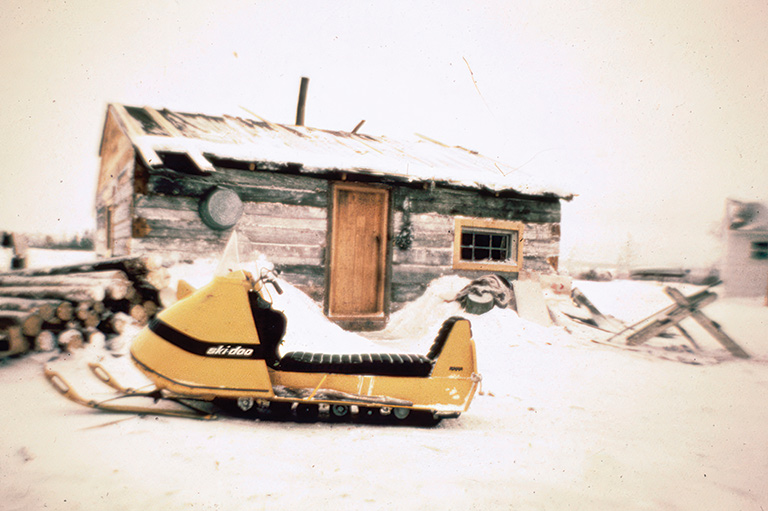
Travelling over snow changed forever in 1922, when 15-year-old Joseph-Armand Bombardier was given an old Model T Ford by his father. The younger Bombardier refurbished the motor, attached it to a sleigh frame with runners and added a wooden propeller. It didn’t last long. His father — worried about the boy’s safety — made him take the contraption apart.
But Bombardier’s passion for invention endured, leading him to study electrical and mechanical engineering in Montreal. Returning to his hometown of Valcourt, Que., he opened a workshop where he repaired cars and farm equipment while also developing reliable winter transportation for rural communities. Then, tragedy struck. In 1934, his two-year-old son died after the family couldn’t reach a hospital in the deep winter snow. With renewed determination, the following year Bombardier developed a rubber-cushioned track system — much like that of a tank — providing effective traction in winter conditions. Three years later, he patented a revolutionary design that combined front-steering skis with a tracked drive system — a concept that remains the foundation of modern snowmobiles.
In 1959, Bombardier — the company Joseph- Armand opened in 1942 — introduced the first Ski-Doo, a smaller single-rider version of its larger snow vehicles. The invention helped transform snowmobiling into one of Canada’s most popular winter pastimes. Today, Canada accounts for 34 per cent of new snowmobile sales worldwide, supported by more than 120,000 kilometres of organized trails countrywide.
Canada’s winter festivals are rooted in Indigenous traditions, European celebrations and the tourismdriven carnivals that emerged in Canadian cities in the late 19th century. Today, these festivals reflect a distinctly Canuck embrace of winter as a time for community, creativity and fun.
Mummers Festival, St. John’s, N.L.: A celebration of Newfoundland and Labrador’s holiday tradition of mummering — when disguised visitors travelled from house to house spreading cheer — that features craft workshops and cultural events, and culminates in the annual Mummers Parade. Dates TBD
Carnaval de Québec, Quebec City: Dating back to 1894, with the modern annual version launching in 1955, it’s the world’s largest winter carnival, drawing more than 500,000 visitors for parades, ice sculptures and festivities. Feb. 5 to 14, 2027
Winterlude, Ottawa: A beloved celebration since 1979, featuring ice-skating, sculptures, live music and snow activities. Jan. 29 to Feb. 15, 2027
Festival du voyageur, Winnipeg: A 10-day celebration of French-Canadian and Métis heritage through music, cuisine, arts and fur-trade history. Feb. 12 to 21, 2027
Frost Regina: A 10-day festival spread across four neighbourhoods that offers ice slides, skating, dog sledding and markets. Dates TBD
Silver Skate Festival, Edmonton: A celebration of the coldest season, which began by featuring Dutchrooted winter traditions through food, sports and arts, and now offers skating, snow sculptures, live performances, winter races that visitors can take part in and Indigenous programming. Feb. 5 to 15, 2027
Snowking Castle Festival, Yellowknife: A month-long arts and entertainment festival held inside a grand snow castle overlooking Great Slave Lake. March 1 to 28, 2027
Griz Days, Fernie, B.C.: A community winter carnival honouring the mythical mountain man “the Griz” with lumberjack shows, ski competitions and parades. March 5 to 7, 2027
We hope you will help us continue to share fascinating stories about Canada’s past.
We highlight our nation’s diverse past by telling stories that illuminate the people, places, and events that unite us as Canadians, and by making those stories accessible to everyone through our free online content.
Canada’s History is a registered charity that depends on contributions from readers like you to share inspiring and informative stories with students and citizens of all ages — award-winning stories written by Canada’s top historians, authors, journalists, and history enthusiasts.
Any amount helps, or better yet, start a monthly donation today. Your support makes all the difference. Thank you!
Advertisement