Your history. Your inbox.
7 uniquely curated newsletters to choose from.


This lesson is part of the Investigating the Histories of Women / Conjuguer nos histoires au féminin collection and is suitable for grade 10 to 12.
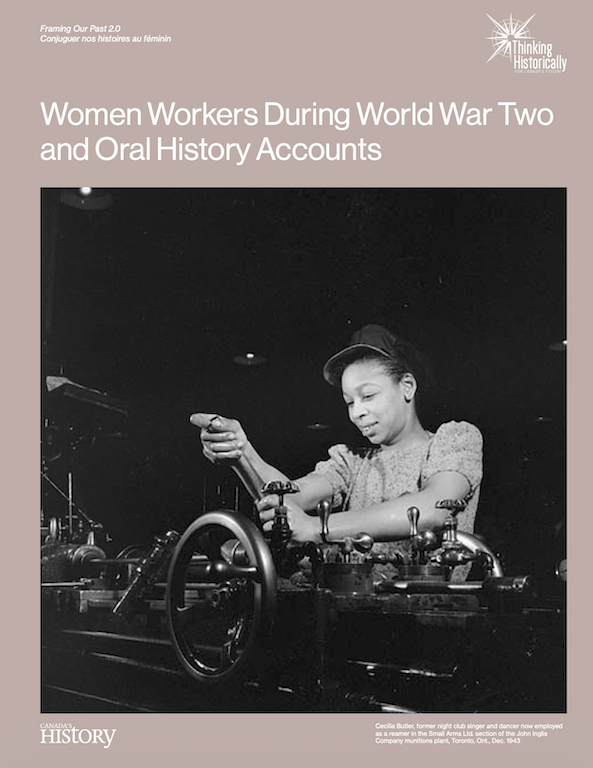
There are a number of misconceptions regarding women’s work during the Second World War. Contrary to common belief, women held diverse positions of work during the pre-war, war, and post-war periods. Throughout these periods, women faced discrimination based on race and gender.
The perspectives of some women workers were captured and transmitted through oral accounts, through diaries, newspapers and published sources. Each one of these sources provide insight into women’s lives, keeping in mind that these narratives were crafted during the restrictions of war. In this lesson, learners will research women’s lives using oral history. In addition, through a close examination of photographs, oral accounts, and secondary sources from historians, learners will evaluate how the status of different groups of working-class women in society changed from the pre- through to the post-war periods. The lesson is not only focused on society’s misconceptions regarding women’s working lives, it is also about whose histories were initially recorded and celebrated. More upper/middle class women than racialized, working-class women’s voices were documented. The imbalance in perspectives also results from how the histories were recorded. Oral history, as a democratizing of history, ensures more women’s voices are preserved.
⇨ What discriminating perspectives existed within society about women in the workforce during the war? How do these perspectives compare to the lived reality of women working during the Second World War in Canada?
⇨ To what extent (or in what ways) did the Second World War change the status of women in society — if at all?
⇨ Why is oral history important when considering perspectives of the past? And how might oral histories provide perspectives not found in textbooks or public war narratives?
Historical Significance | In this lesson students will identify the significance of oral histories in uncovering realities about women’s war and post-war experiences. Learners will examine the significance of women’s wartime and post-wartime work related to shifting intersecting oppressions such as those based on gender, sexuality, race, and class. |
Primary Sources: Evidence | Students learn about the gathering and interpretation of oral primary source evidence as well as the limitations and strengths of oral versus written sources. In this lesson, students will encounter examples of oral primary source evidence as well as be provided with instructions on how to best conduct an oral interview. |
Continuity and Change | This lesson surveys changes in women’s status in the workplace during and following the Second World War through an examination of oral accounts and media representations. Students also reflect on the existence of major barriers for women seeking and maintaining employment. |
Cause and Consequence | Students will gain an understanding of the major causes of women’s exclusion and/or inclusion from the workplace. |
Historical Perspectives | This lesson explores how war and post-war realities were not universal, but rather, shaped by intersecting identities. Students are encouraged to think of wartime identities from the diverse perspective of women workers, women of colour, and LGBTQ2S+ women and critically reflect on how such perspectives are both strategically included and distorted in mainstream representations. |
Advertisement
We acknowledge the generous support of Canada’s History, Ontario Women’s History Network, Thinking Historically — For Canada’s Future Research Project, University of Ottawa Faculty of Education and SSHRC — CRSH. We also want to thank McGill-Queen’s University Press for granting the rights to use content from the Framing Our Past (2001) original book.