Your history. Your inbox.
7 uniquely curated newsletters to choose from.


This lesson is part of the Investigating the Histories of Women / Conjuguer nos histoires au féminin collection and is suitable for grade 10 to 12.
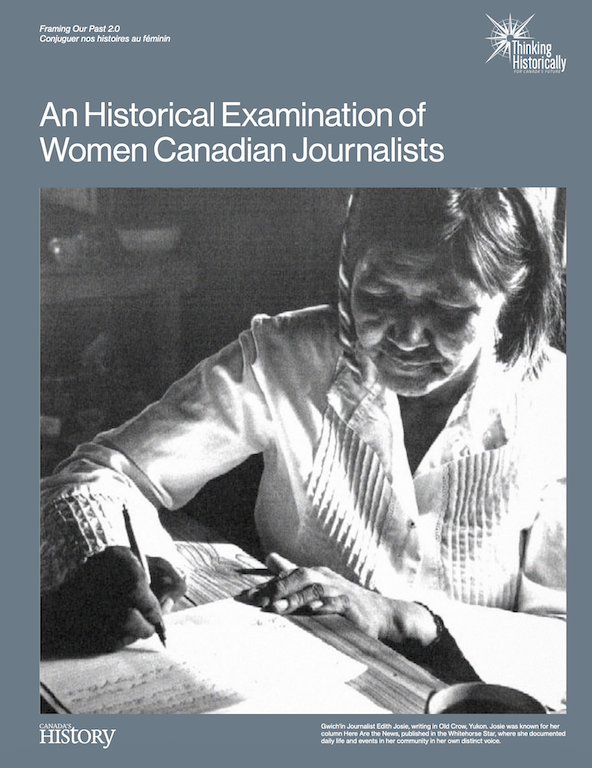
The fight for women’s suffrage in the early 20th century and the second wave of the women’s movement in the 1960s and 1970s were important periods for women entering the field of journalism in Canada.
Women journalists faced numerous obstacles, including from editors, publishers, and the public at large. Despite the challenges, their writing helped bring sexism, and diverse oppressions such as racism, into the public eye and sparked important debates that changed Canadian society. Women working in journalism often acted as bridges of understanding between social and cultural groups, as well as between feminist activists and the general population. By examining the diverse professional experiences of selected journalists, this lesson highlights how their work impacted Canadian public life.
⇨ How have women journalists contributed to Canadian public life?
⇨ What challenges and rewards have female journalists experienced through their careers?
Historical Significance | In this lesson, students will identify the historical significance of women entering the professions of journalism and broadcasting during two different feminist periods of history: the turn of the twentieth century during the fight for women’s suffrage, and the onset of what is commonly referred to as “the second wave” or the women’s movement in the 1960s and early 1970s. Students will assess how, over time, women’s careers were shaped by the economic, social and political influences of the day and how they in turn influenced historical events. |
Primary Sources: Evidence | Students will assess bias and omissions in primary source documents. They will have the opportunity to critically analyze sources and reflect on their use as evidence. They will consider primary sources such as photographs and newspaper articles in their critiques. |
Continuity and Change | This lesson focuses on the changes in journalism that took place during the two historical periods covered in the research. As well, it addresses the similarities/obstacles that existed for women over time. Students will consider how individual women responded to these challenges. |
Cause and Consequence | Students will critically assess the consequences of women’s influence as journalists in the realm of the family, the labour market and in society at large. To do so, students will analyze some of the issues addressed by the journalists in their publications and the ways in which they approached difficult topics. |
Historical Perspectives | Students will assess the impact of women entering the profession of journalism and broadcasting and will examine how they contributed to understanding of issues such as feminist politics, gender equity, and bias/objectivity in reporting. Given the importance of reporting on political, social and economic issues, they will explore how women negotiated their roles and contributed to our understanding of a range of perspectives on public and private life. |
Advertisement
We acknowledge the generous support of Canada’s History, Ontario Women’s History Network, Thinking Historically — For Canada’s Future Research Project, University of Ottawa Faculty of Education and SSHRC — CRSH. We also want to thank McGill-Queen’s University Press for granting the rights to use content from the Framing Our Past (2001) original book.