Your history. Your inbox.
7 uniquely curated newsletters to choose from.


This lesson is part of the Investigating the Histories of Women / Conjuguer nos histoires au féminin collection and is suitable for grade 10 to 12.
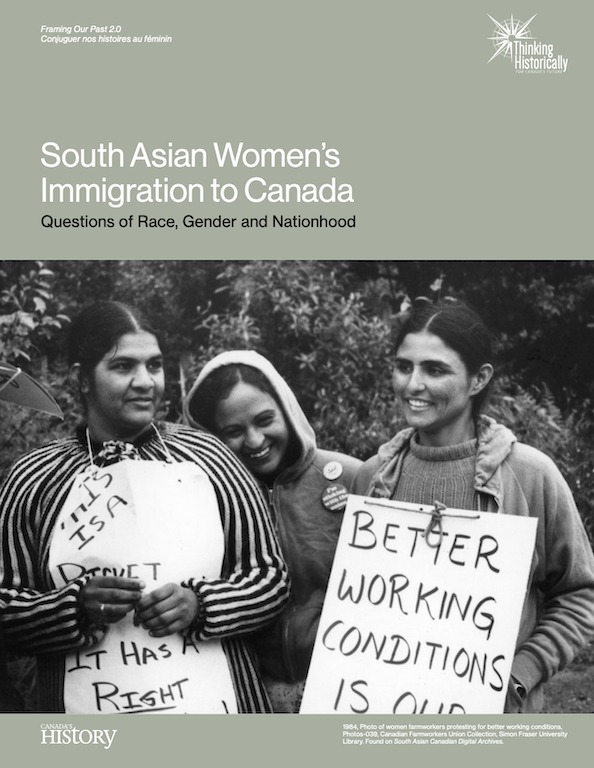
South Asian women have faced significant barriers to immigration throughout the 19th and 20th centuries. Public discussions of race, gender, and nationhood, including debates over discriminatory immigration policies, impacted the way in which Canada was imagined and constructed as a country.
In these discussions, South Asian women often held an ambiguous place, viewed as either dangerous and/or desirable to the Canadian nation-building project. Despite the fact that South Asian-Canadian women were the target of exclusionary immigration policies that dually impacted them because of both their race and gender, they have made significant contributions to their communities as leaders and activists. By examining diverse historical representations, this lesson encourages learners to draw connections between historic forms of discrimination in Canadian immigration policy, South Asian women’s experiences of immigration, and contemporary notions of “Canadianness.”
⇨ How have Canadian immigration regulations impacted the lives of South Asian women and their communities?
⇨ What roles do concepts such as race, gender and class play in shaping immigration policy and notions of Canadian identity?
Historical Significance | In this lesson, students will examine the historical significance of debates over Canadian immigration policies, and questions of Canadian nationhood at the beginning of the 20th century. They will also investigate the long-term impact of these debates by connecting them to contemporary events and conversations. |
Primary Sources: Evidence | Students will examine biases and omissions in primary source documents. They will learn to assess which voices are included and which ones are omitted, and whose opinions are highlighted in news media coverage of debates over immigration policies. |
Continuity and Change | In comparing previous and current immigration policies, students will determine what has remained the same and what has changed over time, with particular attention paid to aspects of identity that impact immigration requirements. |
Cause and Consequence | Students will critically assess the causes and consequences of discriminatory immigration policies. They will examine the numerous issues influencing public debates regarding immigration during this period, including concerns related to race, gender and class, as well as understandings of Canadian identity and nationhood. |
Historical Perspectives | Students will examine debates over immigration policies as they occurred at the turn of the 20th century from the perspective of the different groups involved. In addition, students will analyse the historical perspectives of racialized women which are often overlooked in historical inquiry. By highlighting the historical perspectives of South Asian women, their resistance to discriminatory policies, and their contributions to Canadian society, students will understand the long-term impacts of political decisions on specific ethnocultural communities. |
Advertisement
We acknowledge the generous support of Canada’s History, Ontario Women’s History Network, Thinking Historically — For Canada’s Future Research Project, University of Ottawa Faculty of Education and SSHRC — CRSH. We also want to thank McGill-Queen’s University Press for granting the rights to use content from the Framing Our Past (2001) original book.