
Meira C.
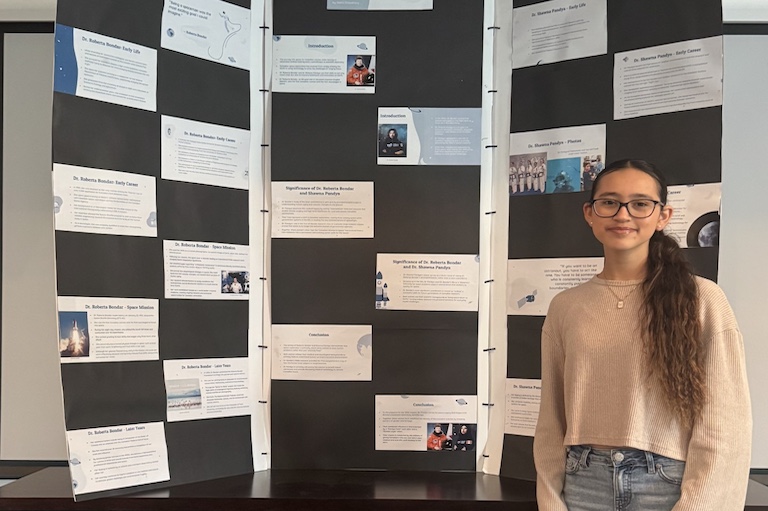
Influential Canadian Women in Space: Roberta Bondar and Shawna Pandya
Meira C.
Southern Alberta Regional Heritage Fair
Lethbridge, AB
This project explores the incredible careers of two extraordinary Canadian women, Dr. Roberta Bondar, the world’s very first neurologist in space, and Dr. Shawna Pandya, an elite physician, aquanaut, and martial artist, who is currently preparing for her first space flight in late 2026 or early 2027. This journey began in the 1980s when Dr. Bondar broke down the rigid gender barriers at the time to become part of Canada's "Final Six" astronauts, eventually making history aboard Space Shuttle Discovery in 1992. During her grueling mission, she orbited Earth 129 times, and led vital life science experiments tracking how microgravity affects the human nervous system. Decades later, her historic flight provided an actual blueprint for Dr. Pandya, who rigorously trained in extreme environments, from camping near grizzly bears to commanding underwater NEPTUNE missions and executing parabolic flight (a simulated feeling of microgravity) campaigns to test commercial spacesuits. Today, Dr. Pandya is scheduled to fly as part of the first all-female research crew scheduled to fly on Virgin Galactic.
My response to the inquiry question is that a deep background in medicine is not just a secondary skill, but the ultimate tool for human survival and innovation in space. By mastering how extreme environments alter human biology, both women successfully brought groundbreaking science back down to Earth. Dr. Bondar's microgravity research on space adaptation directly advanced our understanding of human aging, bone loss, and cardiovascular decline. Dr. Pandya is utilizing this knowledge to pioneer advanced telemedicine and virtual reality tools that bring life-saving, high-level healthcare directly to isolated and rural Canadian communities.
What sources and evidence did you consult for your project? What different perspectives did they provide on your topic?
The sources and evidence consulted include space agency biographies from NASA and the CSA, news articles, and academic review papers. Historical sources showed the rigid government systems Dr. Bondar had to fight through in the 80s and 90s to make it into space, while modern sources show how space exploration has shifted into a new commercial era where private citizen-scientists, such as Dr. Pandya, can contribute to this field.
I also received a completely unique perspective by directly interviewing Dr. Shawna Pandya myself. She told me she uses her martial arts training to stay calm during underwater missions. She relies on the principles of self-control and perseverance when things go wrong, and she takes a breath and “works the problem out ” step-by-step. Furthermore, connecting to my own science fair project on UV light and DNA, I asked Dr. Pandya about protecting astronauts from Mars radiation. She shared an exciting concept called 'onco-editing,' which involves potentially using elephant genes, because they have extra DNA-repair genes, to help humans fix their own DNA damage while in space.
What is the historical significance of your topic?
These two women were very significant in the development of breakthroughs in the medical and astronautics fields. Dr. Bondar initially broke down gender barriers and developed and continued previous research into space adaptation syndrome, leading to a huge breakthrough explaining why astronauts feel dizzy or lightheaded after landing on Earth. Dr. Pandya is currently dedicated to commercial spacesuit testing and suborbital flight medicine, which will directly benefit elderly patients in remote areas. Their space research accelerated what we know about human aging, bone loss, and cardiovascular decline, turning orbital science into real-world healthcare and remote medical tools for Canadians on Earth. Together, these incredible women have shifted the idea and reality of space travel, as now a Canadian woman in space is not a rare, one-time historical milestone, but an evolving career path for future generations.
Why did you choose this topic?
I have always been interested in how space exploration can be applied to solve complex biological problems right here on Earth, which connected perfectly with my own science fair project analyzing ultraviolet light and DNA damage. I wanted to explore the incredible ways that space medicine scientists and astronauts protect human health in extreme environments, such as Dr. Pandya's insights into using "onco-editing,” or elephant genes to help humans fix their own DNA damage while exposed to harsh ultraviolet radiation on missions to Mars, and sometimes even the moon. I was also inspired by the generational representation in Canada, and I wanted to explore the incredible story of how a 7-year-old girl of Indian heritage from Alberta could watch Dr. Bondar's 1992 mission, and realize she had a connection (both being Canadian Girl Guides), and use that as a step-by-step “blueprint,” as she calls it, to become a space explorer herself. It shows that history is not just about the past, but rather an ongoing chain reaction where one person's milestone creates an opportunity for the next generation to achieve something legendary. I chose this topic because I wanted to prove that influential figures like Bondar and Pandya are role models with incredible work ethics.